12 tests a longevity check-up orders

TL;DR
ApoB, Lp(a), fasting insulin, calcium score. The basic check-up rarely includes these twelve, and they are precisely the markers that most predict health trajectory over the next twenty years.
In our clinical practice at Plenya, Patrícia arrived with a folder. Inside, the results of a basic check-up freshly done at a lab chain: complete blood count, kidney function, basic lipid panel, fasting glucose, TSH, urinalysis. Fifty-two lines in total.
Missing: ApoB. Missing: Lp(a). Missing: fasting insulin. Missing: transferrin saturation alongside ferritin (the latter was there, isolated). Missing: coronary artery calcium score.
The folder was thick. But, to our team, it left unanswered the clinical questions that matter most for her future.
A basic check-up answers one question. Longevity demands another.
The conventional check-up was designed for a specific and legitimate question: do you have any disease established today? Complete blood count, kidney function, basic lipid panel, glucose, urine, thyroid. These tests remain essential — they work as the background and continue to be ordered in Continuum Plenya.
The question that shifts preventive care is another: where is your health headed over the next twenty years? To answer it, you need to add a layer with greater predictive power: number of atherogenic particles, early insulin resistance, subclinical inflammation, ovarian reserve, coronary plaque already present in ascending curve.
It is not a question of "doing more" or "doing less." Through The ACTS Method (Activity, Alimentation & Smart Adjuncts · Clinical Optimization · Tending Mind, Body & Bonds · Sleep, Rhythm & Recovery) we apply at Plenya, the orienting question is always: doing what matters.
The list that follows does not replace consultation. Each test may be indicated or contraindicated depending on context — age, sex, family history, symptoms. But it gives an axis for the conversation worth having.
The 12 tests that change the reading
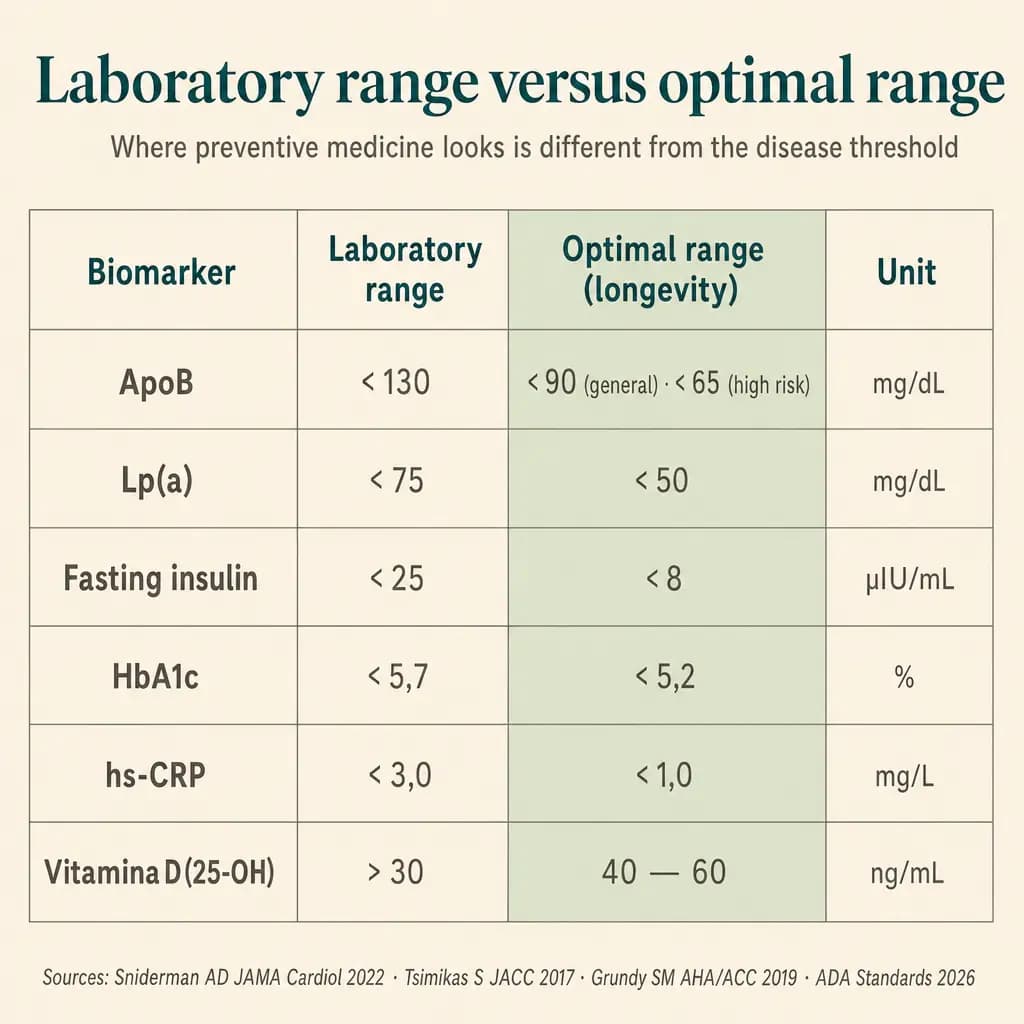
1. ApoB (apolipoprotein B). Measures the number of atherogenic particles in circulation: every LDL, IDL, VLDL, and Lp(a) carries one ApoB molecule. The Sniderman, Navar, and Thanassoulis review published in 2022 in JAMA Cardiology synthesized decades of literature showing that ApoB is a better predictor of cardiovascular events than LDL-C or non-HDL cholesterol, especially in cases of discordance (which are common in metabolic syndrome and diabetes). General target: <90 mg/dL for low risk; <80 for moderate-high risk; <65 for secondary prevention.
2. Lp(a) — lipoprotein(a). Hereditary, measure once in a lifetime (after age 18). About 20% of the population has Lp(a) above the risk threshold. The Tsimikas review in JACC in 2017 establishes Lp(a) as a causal and independent risk factor for coronary disease and calcified aortic stenosis. Target: <50 mg/dL (or <125 nmol/L). Above that, cardiovascular management changes, even with "normal" LDL.
3. Fasting insulin + HOMA-IR. Detects insulin resistance years before glucose climbs. Insulin <8 µIU/mL is desirable; >12 suggests resistance; >20 is already serious. HOMA-IR <2.0 is the clinical target.
4. HbA1c. Average glycation over the last 90 days. ADA 2026 criteria: <5.7% normal, 5.7–6.4% pre-diabetes, ≥6.5% diabetes. More useful than isolated fasting glucose, which captures only one instant.
5. High-sensitivity CRP (hs-CRP). Low-grade inflammation, an independent cardiovascular risk factor. Target <1.0 mg/L. Between 1.0 and 3.0, intermediate risk; >3.0, high risk. Always read alongside acute conditions ruled out (infection, recent injury).
6. Ferritin + transferrin saturation. Together, not isolated. Ferritin alone can mask functional deficiency or be falsely elevated by inflammation. For menstruating adult women, ferritin below 50 with symptoms generally already requires action.
7. TSH + free T4 + free T3. TSH alone misses central dysfunction and altered conversion. This trio gives the full reading of the axis.
8. Vitamin D (25-OH). Deficiency widely prevalent in Brazil even in sunny regions. Individualized target: 40–60 ng/mL for most adults.
9. Vitamin B12 + homocysteine. B12 alone may read "normal" (>200 pg/mL) with functional deficiency already established. Homocysteine >10 µmol/L suggests active deficiency of B12, B6, or folate. Important in vegetarians, the elderly, chronic users of metformin or proton pump inhibitors.
10. Total testosterone + free + SHBG (men). Total alone can mislead: those with high SHBG have normal total testosterone but low free testosterone, with real symptoms (fatigue, libido, loss of muscle mass). Ordered together with LH and FSH if there is a hypogonadism picture.
11. Estradiol + FSH + progesterone (perimenopausal women). FSH is the most sensitive marker of declining ovarian reserve. Estradiol alone oscillates too much to be useful by itself. In those still menstruating, draw in the follicular phase (days 3 to 5).
12. Coronary artery calcium score (CAC). Not a blood test, but it belongs on this list. Non-contrast CT, low radiation dose. Measures calcified atherosclerotic plaque in the coronaries. In men >40 and women >50 with intermediate risk, or earlier if there is an early family history, it is the test that most reorganizes the preventive conversation. Done once; repeat in 5 years if zero, depending on management.
In the background of these twelve, always the complete blood count, kidney function (creatinine, urea, AST/ALT), urinalysis, and well-measured blood pressure — these are so basic they don't even count, but they remain indispensable.
The question that precedes each test
The question that precedes ordering any test in our practice is simple: if the result comes back abnormal, what changes in management? If the answer is "nothing" or "we'd order another test to see better," that is not the right test at the right moment.
And the twin question: if the result comes back normal, what changes? If it is "nothing — we'd still investigate the same way," that is also not the right test.
Good tests answer concrete clinical questions and move decisions.
How the Continuum handles this
In Continuum Plenya, the initial panel is not a catalog. Our integrative approach builds it for the patient — age, sex, family history, chief complaint, risk factors. Annual and semi-annual tests enter the score that evolves over time. The decision to order ApoB, Lp(a), CAC, or a complete hormone panel is born of clinical reading.
A well-chosen set of tests, added to the basic check-up already in your routine, is usually worth every penny. And it makes an enormous difference in what one sees — and in what one can change.
References
- Sniderman AD, Navar AM, Thanassoulis G. Apolipoprotein B vs Low-Density Lipoprotein Cholesterol and Non-High-Density Lipoprotein Cholesterol as the Primary Measure of Apolipoprotein B Lipoprotein-Related Risk: The Debate Is Over. JAMA Cardiol, 2022;7(3):257-258.
- Tsimikas S. A Test in Context: Lipoprotein(a): Diagnosis, Prognosis, Controversies, and Emerging Therapies. J Am Coll Cardiol, 2017;69(6):692-711.
- Grundy SM et al. 2018 AHA/ACC/Multisociety Guideline on the Management of Blood Cholesterol. Circulation, 2019;139(25):e1082-e1143.
- American Diabetes Association. 2. Diagnosis and Classification of Diabetes: Standards of Care in Diabetes—2026. Diabetes Care, 2026;49(Suppl 1):S27-S49.