Apnea in those who don't snore: the invisible female form

TL;DR
A 42-year-old woman, lean, no snoring, treated for years for "anxiety." Polysomnography comes back "no significant apnea." But the clinical picture persists, because the threshold was designed for the average man, and her phenotype doesn't fit.
Patrícia is 42. Lean (BMI 22.8). She doesn't snore, her husband confirms it. She came to the Plenya team for anxiety, referred by a colleague. She has been on sertraline for four years, prescribed by a competent psychiatrist. Some afternoons she takes alprazolam as rescue. Even so, she describes life this way: I wake up tired. My head feels scrambled all day. At night it takes me a while to fall asleep because my heart races. When I sleep, it's light. I have neck pain, jaw pain, queasiness.
In our clinical practice, this pattern is frequent, and almost always invisible to a hurried look.
Before reaching us, Patrícia had already had a polysomnography. The report said: "apnea-hypopnea index 3.2 events/hour, minimum saturation 92%, no evidence of significant obstructive apnea." The physician who ordered it discharged the topic. It's not apnea, she heard. Treat the anxiety.
The report was technically correct. The reading was not.
The apnea we recognize, and the one we miss
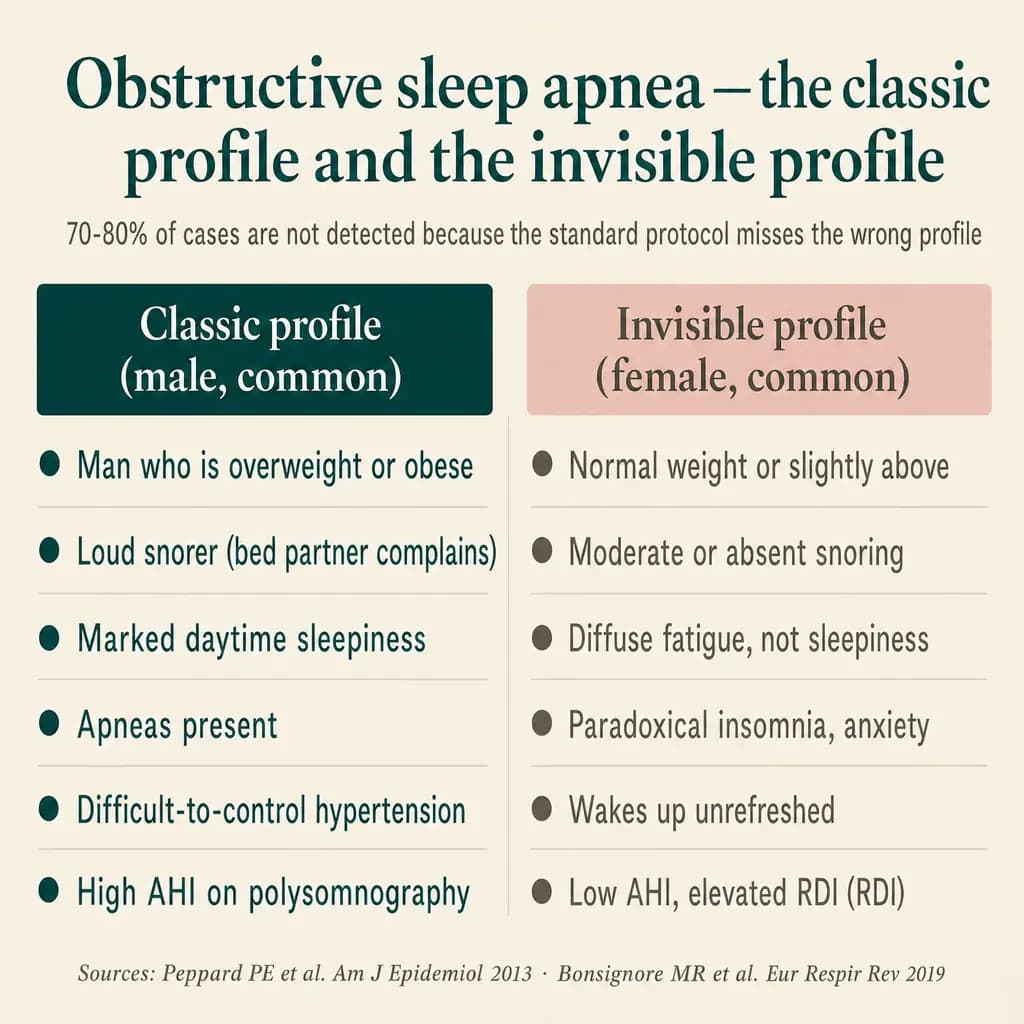
"Classical" obstructive sleep apnea was described in middle-aged men, overweight, thick neck, loud snoring, witnessed pauses by the wife, marked daytime sleepiness. AHI (apnea-hypopnea index) is the standard metric: pauses and marked reductions in airflow, with desaturation or arousal. When the AHI is high, no one misses the diagnosis.
The problem is what sits below the threshold. The EPISONO study (Tufik and colleagues, Sleep Medicine, 2010), conducted in São Paulo on a population sample, found obstructive apnea in 32.8% of adults in the city. In women, prevalence rises with age and surges after menopause. The Swiss HypnoLaus cohort, in 2015, showed the same pattern in a different geography: 23.4% of adult women had AHI ≥15.
But women reach the sleep lab less often. Young and colleagues showed, in a classic 1996 paper in Arch Intern Med, that women were referred for investigation 8 to 10 times less than men with equivalent severity. Outpatient screening valued snoring and daytime sleepiness, male symptoms. The female presentation (insomnia, fatigue, morning headache, anxiety, low mood) went unnoticed. The review by Bonsignore, Saaresranta, and Riha (European Respiratory Review, 2019) consolidated decades of this observation: the classical male presentation, for decades, became the operational definition; women fell outside it.
And there is a parallel chapter, described still in the 1990s by Christian Guilleminault at Stanford (Chest, 1996), and deepened by Gold and colleagues in 2003 in the same journal: patients with increased upper airway resistance without formal apnea criteria could still have fragmented sleep, elevated nocturnal blood pressure, and a symptom set overlapping with chronic fatigue, chronic pain, and anxiety. The literature called this phenomenon UARS. In day-to-day clinical work, the name matters less than the concept: respiratory sleep fragmentation can exist below the AHI threshold, especially in lean women.
Why "mild" AHI is misleading in women
Mild apnea in men is, frequently, mild indeed. In a woman with a compatible symptomatic phenotype (refractory fatigue, non-restorative sleep, chronic head and jaw pain, bruxism, awakenings with tachycardia, nocturia without urological cause), a low AHI may be masking something more.
Three reasons:
- Female pauses are shorter and less deep. Instead of frank apnea with desaturation, flow limitation predominates: the patient keeps breathing, but with elevated work, generating micro-arousals that fragment sleep. Many of these events do not reach the formal hypopnea criterion and stay out of the AHI.
- Saturation is preserved. Women generally desaturate less per event. Whoever reads only "minimum SpO₂" walks away reassured. Sleep fragmentation, however, is real, and it is what produces the symptom.
- Events concentrate in REM. In women, sleep-disordered breathing is frequently REM-dependent. If the AHI is calculated over the whole night, it dilutes what happened in the last 90 minutes of sleep. A good report separates AHI in REM from non-REM. Worth looking.
This is not an expensive exam or a research technique. It is reading the exam the patient has already had. Standard Type I polysomnography, available in any sleep lab in Brazil, already includes nasal pressure cannula, EEG, oximetry, body position, and sleep stages. In the hands of an experienced sleep physician, that report tells the story, even when the formal AHI is low.
When the patient brings a "normal" report and the symptomatic picture is loud, it is worth asking for the flow tracing (not just the summary numbers), the arousal index, and fragmentation by hour of sleep. In some cases, repeating the exam after refining the clinical suspicion is also reasonable.
What to treat, and how, in Brazilian clinical practice
The good news: the picture frequently responds well to approaches available in any mid-sized-city office in Brazil.
Targeted ENT assessment. Allergic rhinitis, septal deviation, turbinate hypertrophy, high palate, enlarged tonsils, anything that increases upper airway resistance worsens the picture. In a lean woman with non-restorative sleep, ENT belongs in the workup.
Assessment with a dentist trained in sleep dentistry. The Brazilian Association of Sleep Dentistry (ABROS) credentials professionals with specific training. The mandibular advancement device (MAD), individually fitted, is first-line in mild-to-moderate apnea in the lean phenotype, with adherence typically higher than CPAP. Reasonable cost, available in capitals and mid-sized cities.
Sleep-focused speech-language therapy. The randomized trial by Guimarães and colleagues, conducted at InCor/USP and published in 2009 in the American Journal of Respiratory and Critical Care Medicine, showed significant AHI reduction in moderate apnea with orofacial myofunctional therapy: exercises that strengthen tongue, palate, and pharyngeal musculature. Brazilian, later replicated in other centers. Accessible.
Treatment of rhinitis and nasal obstruction. Not a detail. May be topical nasal corticosteroid, antihistamine, treatment of allergic cause. Reduces resistance, improves sleep.
Serious sleep hygiene. Alcohol out or drastically reduced (relaxes the airway, worsens it). Lateral decubitus. Cool room. Last meal light and at least three hours before bedtime.
CPAP in selected cases. In mild apnea with female phenotype, CPAP is not usually first choice: low adherence, frequent residual symptoms. Reserved for when there is a comorbidity that justifies it (refractory hypertension, atrial fibrillation, cognitive impairment, failure of other measures). When indicated, low pressures usually suffice.
Treatment of associated bruxism. A myorelaxant splint made by a dentist, to protect dentition and reduce jaw pain. Not treatment for the apnea, but management of collateral damage.
The reading the Continuum makes
This is a clear example of the diagnosis lost in a 30-minute visit with a short complaint list. It demands a long-form history: teeth grinding, morning pain, sleep position, nighttime awakenings to urinate (nocturia without urological cause is data), mouth breathing, dryness on waking, mouthguard use.
In Continuum Plenya, the initial panel includes structured screening for sleep-disordered breathing (STOP-BANG and Berlin Questionnaire, with the critical caveat that they were validated predominantly in men and should not be the final filter), the Epworth Sleepiness Scale, the Pittsburgh Sleep Quality Index. When the picture calls for it, especially in women with chronic fatigue, refractory anxiety, or chronic head and jaw pain, direct referral to Type I polysomnography, with ENT and dental assessment in parallel. Through The ACTS Method (Activity, Alimentation & Smart Adjuncts · Clinical Optimization · Tending Mind, Body & Bonds · Sleep, Rhythm & Recovery), the team reassesses the picture at 3 and 6 months to adjust management.
The Patrícia from the beginning of the story fitted a MAD 14 months ago. In parallel, she treated the rhinitis with an ENT, began myofunctional therapy with a sleep-focused speech-language pathologist, cut out the evening wine, started sleeping on her side. She reduced sertraline in conversation with the psychiatrist (she did not cut it, she reduced it, with judgment). At six months, she stopped alprazolam entirely. At ten months, she described in the visit the sentence we hear when the diagnosis was right: I didn't know one could wake up rested.
The "anxiety" was never just anxiety. It was an airway working too hard at night, a brain fragmented by micro-arousals, and four years of treatment on the wrong avenue.
A tired woman at 42 is not always hormones. Sometimes it is a breath no one listened to properly.
References
- Tufik S, Santos-Silva R, Taddei JA, Bittencourt LRA. Obstructive sleep apnea syndrome in the São Paulo Epidemiologic Sleep Study. Sleep Med, 2010;11(5):441-446.
- Heinzer R et al. Prevalence of sleep-disordered breathing in the general population: the HypnoLaus study. Lancet Respir Med, 2015;3(4):310-318.
- Young T, Hutton R, Finn L, Badr S, Palta M. The gender bias in sleep apnea diagnosis: are women missed because they have different symptoms? Arch Intern Med, 1996;156(21):2445-2451.
- Guilleminault C, Stoohs R, Kim YD, Chervin R, Black J, Clerk A. Upper airway resistance syndrome, nocturnal blood pressure monitoring, and borderline hypertension. Chest, 1996;109(4):901-908.
- Gold AR, Dipalo F, Gold MS, O'Hearn D. The symptoms and signs of upper airway resistance syndrome: a link to the functional somatic syndromes. Chest, 2003;123(1):87-95.
- Bonsignore MR, Saaresranta T, Riha RL. Sex differences in obstructive sleep apnoea. Eur Respir Rev, 2019;28(154):190030.
- Guimarães KC, Drager LF, Genta PR, Marcondes BF, Lorenzi-Filho G. Effects of oropharyngeal exercises on patients with moderate obstructive sleep apnea syndrome. Am J Respir Crit Care Med, 2009;179(10):962-966.