Why the nephrologist sees it first — the cardio-renal-metabolic axis

TL;DR
The biggest revolution in preventive medicine in recent years was understanding that heart, kidney, and metabolism are a single system. And that the kidney usually speaks first.
The biggest revolution in preventive medicine over the past five years was not a surgery, was not an isolated drug. It was a reorganization: understanding that heart, kidney, and metabolism are not three separate systems — they are a single system, with a single inflammatory root and a single therapeutic axis.
The technical name is the cardio-renal-metabolic axis, formalized by the American Heart Association in 2023 in a statement by Ndumele and colleagues. What our team organizes around it, in our clinical practice at Plenya, is the perception that chronic kidney disease rarely begins in the kidney. It begins in long-standing metabolic inflammation, in poorly controlled hypertension, in silent hyperinsulinemia, in subclinical endothelial dysfunction.
And the kidney, by a simple physiologic feature — extremely high-precision filtration over a delicate vascular bed — usually signals first. Microalbuminuria, slow decline of estimated glomerular filtration rate, loss of functional reserve. Signs that appear ten or fifteen years before the severe picture.
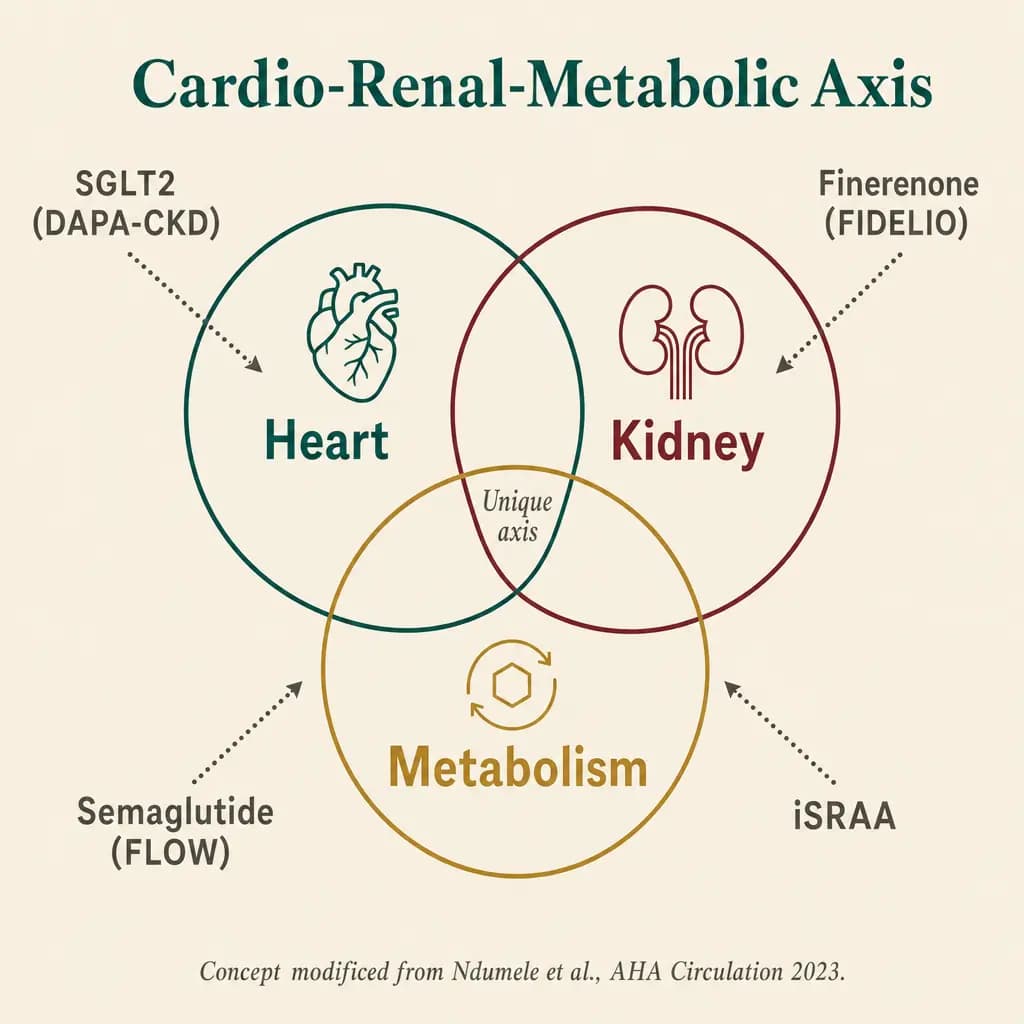
That is why the nephrologist, when trained to look at the silent window, sees it first. The test most frequently ordered — kidney function — is, paradoxically, one of the best early markers of systemic disease. Through The ACTS Method (Activity, Alimentation & Smart Adjuncts · Clinical Optimization · Tending Mind, Body & Bonds · Sleep, Rhythm & Recovery) we apply, this single insight reorganizes the entire preventive agenda.
The pharmacological landmarks of the last decade confirm the axis in clinical practice. SGLT2 inhibitors came first: DAPA-CKD (Heerspink, NEJM 2020) showed reduction in chronic kidney disease progression and cardiovascular death with dapagliflozin even in non-diabetic patients. EMPA-KIDNEY (NEJM 2023) confirmed the effect in a broader cohort. Finerenone, in FIDELIO-DKD (Bakris, NEJM 2020), demonstrated a reduction in renal and cardiovascular events in type-2 diabetes with nephropathy. More recently, FLOW (Perkovic, NEJM 2024) brought semaglutide into the game: a 24% reduction in the composite renal-cardiovascular endpoint in patients with T2D and CKD.
Three different drug classes, three different targets — all protecting the three systems in parallel. It is not coincidence. It is the clinical confirmation that the axis is real.
Preventive nephrology is not a new specialty. It is a way of reading nephrology that is finally being accepted.
Excerpt from Chapter 9 of the book BEFORE — The silent window between normal and optimal — a decade where health is decided.
References
- Heerspink HJL, Stefánsson BV, Correa-Rotter R, et al. "Dapagliflozin in Patients with Chronic Kidney Disease." N Engl J Med. 2020;383(15):1436-1446.
- EMPA-KIDNEY Collaborative Group, Herrington WG, Staplin N, et al. "Empagliflozin in Patients with Chronic Kidney Disease." N Engl J Med. 2023;388(2):117-127.
- Bakris GL, Agarwal R, Anker SD, et al. "Effect of Finerenone on Chronic Kidney Disease Outcomes in Type 2 Diabetes." N Engl J Med. 2020;383(23):2219-2229.
- Perkovic V, Tuttle KR, Rossing P, et al. "Effects of Semaglutide on Chronic Kidney Disease in Patients with Type 2 Diabetes." N Engl J Med. 2024;391(2):109-121.
- Ndumele CE, Rangaswami J, Chow SL, et al. "Cardiovascular-Kidney-Metabolic Health: A Presidential Advisory From the American Heart Association." Circulation. 2023;148(20):1606-1635.