Coronary calcium score: the test that changes a decade

TL;DR
It is a quick CT scan, no contrast, no needle, with a radiation dose comparable to a mammogram. And what it shows — or fails to show — recalibrates the next ten years of the patient's heart in our integrated panel.
Henrique is 46. Engineer, two children, runs on weekends. His father had a heart attack at 58. He arrived at our clinic at the insistence of his wife — my father's cardiologist said everything was fine with him a year before the heart attack. I want to know what's happening inside me.
In our clinical practice at Plenya, that request is one we recognize. It is the request of someone who watched a parent fall and no longer trusts the "all normal" stamp on the lab printout.
His initial workup, read by our team: blood pressure 124/78. Total cholesterol 198, LDL 122, HDL 48. Fasting glucose 92. By the traditional Framingham score, "low to moderate" risk — no statin indicated. By the AHA 2018 risk score, 10-year risk calculated at 4.8%. Cleared to go on with life, in the conventional reading.
We ordered a coronary calcium score. Result: 187. Above the 90th percentile for age.
The conversation our team had with Henrique in the next visit was different from the one he expected.
What this test measures, exactly
The coronary calcium score — CAC, from coronary artery calcium — is a CT scan of the heart performed without contrast, without needle, in a few seconds of breath-hold. The radiation dose is around 1 mSv, comparable to a mammogram. Fifteen minutes from arrival to exit.
What the test does is simple: it identifies and quantifies calcium deposits in the walls of the three main coronary arteries. Calcium in the coronaries only exists if there is calcified atherosclerotic plaque. It is not a false positive. It is the fingerprint of a disease that took hold silently, over years, even while the blood tests said "normal."
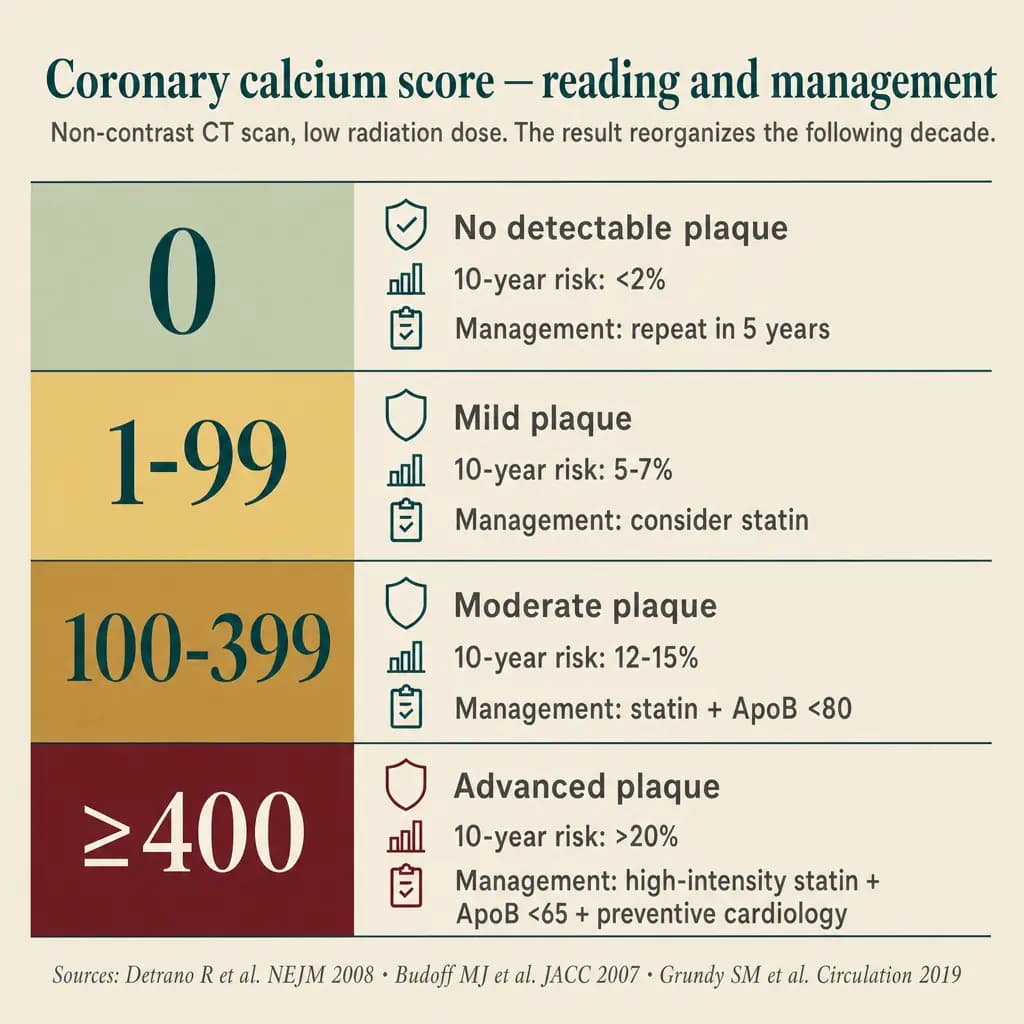
The result comes in points, by the Agatston methodology. The clinical reading our team uses is direct:
- Score 0 — no calcium detected. Risk of cardiovascular event over the next 5 to 10 years extremely low.
- Score 1 to 100 — plaque present, but in small volume. Intermediate risk.
- Score 101 to 400 — established and moderate atherosclerotic disease. Elevated risk.
- Score above 400 — extensive disease, frequently justifying management equivalent to a patient who has already had a heart attack.
The datum that reorganizes the conversation
The MESA study (Multi-Ethnic Study of Atherosclerosis), published by Detrano and colleagues in the New England Journal of Medicine in 2008, followed 6,722 adults from four ethnic groups for an average of nearly 4 years. Compared with people with a score of zero, the adjusted risk of a coronary event was 7.73 times higher in those with a score between 101 and 300, and 9.67 times higher in those with a score above 300. These values are independent of traditional risk factors — cholesterol, blood pressure, diabetes, smoking.
In 2007, Budoff and colleagues published in the Journal of the American College of Cardiology an analysis of 25,253 asymptomatic individuals followed for an average of 6.8 years. The hazard ratios for total mortality ranged from 6.7-fold (score 11–100) to 62.6-fold (score above 1,000), compared with score zero. The authors demonstrated that adding the CAC to traditional risk factors raised the C-statistic from 0.61 to 0.81 — an enormous jump in predictive capacity.
In 2015, McClelland published in JACC a MESA risk score that incorporates the CAC alongside traditional factors. Including CAC significantly improved discrimination for 10-year coronary events (C-statistic 0.80 vs. 0.75).
The 2018 American cholesterol guideline (AHA/ACC) formally recognized the CAC as a tool to reclassify risk in adults at intermediate risk — exactly the band where the decision to treat or not to treat is hard. In those with a score of zero who do not smoke, are not diabetic, and have no early family history, the statin recommendation can be deferred or withdrawn. In those with a score above 100, or above the 75th percentile for age, the recommendation moves the opposite way: treat more aggressively.
The warranty period of a zero score
A reasonable question we hear often in the consulting room: if it came back zero, when to repeat?
The Dzaye and colleagues analysis, published in JACC: Cardiovascular Imaging in 2021, examined exactly this using MESA data. The "warranty period" — the average time until the score ceases to be zero — varies from 3 to 7 years depending on sex, ethnicity, and risk profile. In men with diabetes or multiple factors, the interval is shorter. In a young woman, with no risk factors, no family history, it can reach 7 years or more.
In our clinical practice, this translates into a useful rule of thumb the team applies: zero score with no risk factors = repeat in 5 to 7 years. Zero score with diabetes or smoking = repeat in 3 years. Score above zero = the test is not repeated to "monitor" — it is repeated to confirm progression, but management has already changed.
When to order, when not to
The CAC is a tool for risk stratification in asymptomatics — it is not a test to investigate chest pain (for that, other exams serve better: CT angiography, stress echocardiogram, catheterization, depending on the case).
Our integrative approach indicates the CAC, distilled from the guidelines:
- Men between 40 and 70 and women between 50 and 70 with intermediate risk (5–20% in 10 years) or with factors that make the decision difficult.
- Before 40 (men) or 50 (women) if there is a family history of premature cardiovascular event: father or brother before 55, mother or sister before 65.
- When there is discrepancy between what the patient feels and what the lab says — the patient who "does everything right" but has elevated ApoB, high Lp(a), or recently diagnosed diabetes.
We generally do not order:
- In asymptomatics under 35 with no factor (calcified plaque is rare, the score is usually zero).
- In those who have already had an event or are already on a statin for clear indication — the result rarely changes management.
- As an "annual routine exam" — that is not how it is used.
What Henrique's exam did
Henrique left the visit understanding, for the first time, that "all normal" on the blood lab does not tell the whole story. He had plaque in place, in non-trivial volume, at age 46. The LDL of 122 that no one would have treated by the standard calculation became, in his context, a target of aggressive reduction — LDL goal below 70 and ApoB below 80, with statin, diet, and strength training recalibrated by the team.
Twelve months later, LDL at 58, ApoB at 65, lost 6 kg (13 lbs), sleeps better, stopped the omeprazole he had been taking for four years for "idiopathic" reflux. The calcium score did not regress — calcified plaque generally does not regress. But the speed of progression changes. And the real risk of an event, over the next ten years, was recalibrated downward in a way no traditional formula could have achieved.
How the Continuum integrates this finding
A calcium score above zero, in Continuum Plenya, is not a stray number in the chart. Through the ACTS Method (Activity, Alimentation & Smart Adjuncts · Clinical Optimization · Tending Mind, Body & Bonds · Sleep, Rhythm & Recovery), it enters the panel alongside ApoB, Lp(a), HbA1c, 24-hour blood pressure, body composition, family history, lifestyle — and the cardiologist, the clinician, and the nutritionist combine the plan that makes sense for that body, at that moment. Follow-up at 6 and 12 months checks what changed, not in the score (which is structural), but across all markers of progression.
The heart that has a heart attack at 55 began to ache at 35. The calcium score is one of the few tools that allows our team to hear that warning while there are still twenty years left to respond.
References
- Detrano R et al. Coronary calcium as a predictor of coronary events in four racial or ethnic groups. N Engl J Med, 2008;358(13):1336-1345.
- Budoff MJ et al. Long-term prognosis associated with coronary calcification: observations from a registry of 25,253 patients. J Am Coll Cardiol, 2007;49(18):1860-1870.
- McClelland RL et al. 10-Year Coronary Heart Disease Risk Prediction Using Coronary Artery Calcium and Traditional Risk Factors: Derivation in the MESA With Validation in the HNR Study and the DHS. J Am Coll Cardiol, 2015;66(15):1643-1653.
- Grundy SM et al. 2018 AHA/ACC/Multisociety Guideline on the Management of Blood Cholesterol. Circulation, 2019;139(25):e1082-e1143.
- Dzaye O et al. Warranty Period of a Calcium Score of Zero: Comprehensive Analysis From MESA. JACC Cardiovasc Imaging, 2021;14(5):990-1002.