The drug that cuts mortality by 80% — and no one prescribes

TL;DR
If a medication with that effect existed, humanity would pay any price for it. That medication exists — and in most consultations the patient is rarely told about it. In our team, we prescribe it with the same rigor as any other intervention.
If a drug existed that reduced all-cause mortality by up to 80%, humanity would pay any price for it.
That drug exists. It is called physical exercise.
The data come from the Cleveland Clinic study published by Mandsager and colleagues in JAMA Network Open in 2018, with 122,000 adults: low cardiorespiratory fitness showed a hazard ratio of 5.04 against elite fitness. For comparison, in the same study: smoking 1.41, diabetes 1.40, coronary disease 1.29.
Sedentary behavior kills more than smoking. It is not provocation. These are the numbers our team revisits with patients in every onboarding panel.
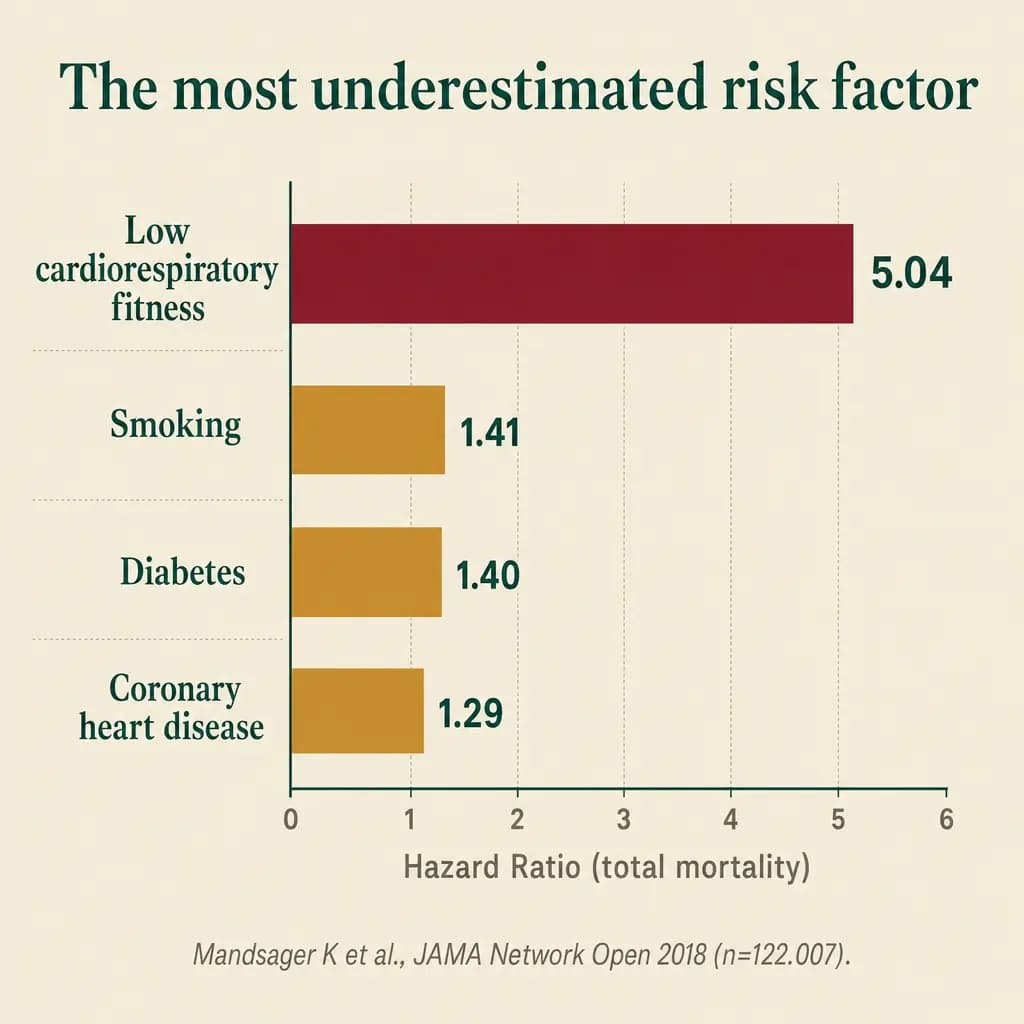
Cardiorespiratory fitness — measured by VO₂ max — is the most powerful prognostic marker in internal medicine. More than systolic blood pressure. More than the lipid profile. More than glucose. The American Heart Association, in 2016, already published a scientific statement (Ross et al.) arguing that cardiorespiratory fitness should be treated as a clinical vital sign — measured and recorded in the chart like blood pressure and heart rate. In our integrative approach at Plenya, that is exactly how the exercise physiologist on the team treats it.
The epidemiologic literature reinforces this at scale. The Wen and colleagues study in Lancet (2011), with more than 416,000 Taiwanese adults, demonstrated that 15 daily minutes of moderate activity already reduce total mortality by 14% and extend life expectancy by three years. The Ekelund meta-analysis (BMJ 2019), with accelerometer data from 36,000 adults, showed that replacing 30 minutes of sedentary time with light activity already reduces mortality — it does not have to be high-intensity exercise. Lavie and colleagues (Circ Res 2019) synthesized the evidence: the effect of sedentary behavior is independent of formal exercise time — sitting too much kills even in those who train.
And exercise is, at the same time, the cheapest marker to improve. It does not require high-cost medication, it does not require state-of-the-art technology. It requires time, structure, and a clinical choice to prescribe exercise with the same rigor with which one prescribes an antihypertensive: dose, frequency, intensity, monitoring. That rigor is what the ACTS Method (Activity, Alimentation & Smart Adjuncts · Clinical Optimization · Tending Mind, Body & Bonds · Sleep, Rhythm & Recovery) — the A pillar — operationalizes inside our continuous care plan.
Excerpt from Chapter 7 of the book BEFORE — The silent window between normal and optimal — a decade where health is decided.
References
- Mandsager K, Harb S, Cremer P, et al. "Association of Cardiorespiratory Fitness With Long-term Mortality Among Adults Undergoing Exercise Treadmill Testing." JAMA Netw Open. 2018;1(6):e183605.
- Ross R, Blair SN, Arena R, et al. "Importance of Assessing Cardiorespiratory Fitness in Clinical Practice: A Case for Fitness as a Clinical Vital Sign. A Scientific Statement From the American Heart Association." Circulation. 2016;134(24):e653-e699.
- Wen CP, Wai JPM, Tsai MK, et al. "Minimum amount of physical activity for reduced mortality and extended life expectancy: a prospective cohort study." Lancet. 2011;378(9798):1244-1253.
- Ekelund U, Tarp J, Steene-Johannessen J, et al. "Dose-response associations between accelerometry measured physical activity and sedentary time and all cause mortality: systematic review and harmonised meta-analysis." BMJ. 2019;366:l4570.
- Lavie CJ, Ozemek C, Carbone S, Katzmarzyk PT, Blair SN. "Sedentary Behavior, Exercise, and Cardiovascular Health." Circ Res. 2019;124(5):799-815.