Ferritin between 30 and 100: the normality that drains women

TL;DR
The lab clears it as normal starting at 15 ng/mL. But our team observes, in patients we follow longitudinally, that menstruating women with ferritin below 50 already live with real symptoms — fatigue, hair loss, dropping performance — without ever having become anemic.
Marcela is 38. A lawyer, two small children, regular and abundant menstrual cycle. For nearly two years she had been feeling a fatigue she herself described as the kind of fatigue coffee doesn't fix. Hair falling in the shower. Shortness of breath climbing two flights of stairs. A treadmill run that used to deliver 7 km, now 4 km and feeling like triple.
She had done a CBC. Hemoglobin 13.1 g/dL — within range. Ferritin 38 ng/mL — the lab stamped it reference value: 13 to 150. All normal, she had heard from two different physicians. It's the routine, it's stress, it's motherhood.
It was none of those — as our team's panel made clear from the first reading.
The normality that is not healthy
Most Brazilian labs report ferritin as "normal" starting at 13 to 30 ng/mL. Those cutoffs were created to flag iron-deficiency anemia — the phase in which the body has already consumed all reserves and hemoglobin has begun to fall. They were not created to flag functional iron deficiency — the earlier phase, in which there is still enough hemoglobin for labs to pass, but no iron left to spare for the demands of tissues.
And the tissues ask a lot.
Iron is a cofactor for mitochondrial enzymes that produce energy, for enzymes involved in neurotransmitter synthesis (dopamine and serotonin depend on it), for hair growth, for the immune response, for muscle contractility. When ferritin falls below a certain band — even with normal hemoglobin — these processes begin to operate at reduced rotation. The body does not fail. It just works in economy mode.
The recent literature has worked to quantify this, and our team uses it as the floor of the conversation.
What the clinical trials say
In 2003, Verdon and colleagues published in the BMJ a double-blind, randomized trial with 144 women aged 18 to 55, with unexplained fatigue, normal hemoglobin, and ferritin below 50 ng/mL. Half received oral ferrous sulfate for four weeks, half received placebo. The reduction in fatigue was significantly greater in the iron group, with the effect concentrated in women with ferritin below 20.
In 2011, Krayenbuehl published in Blood a more radical trial: 90 premenopausal women, fatigued, with ferritin ≤50 ng/mL and normal hemoglobin, randomized to intravenous iron or placebo. At 12 weeks, 82% of those treated reported improvement in fatigue, against 47% on placebo. The effect was most marked in women with ferritin ≤15.
In 2012, Vaucher published in CMAJ another similar trial — 198 menstruating women, normal hemoglobin, ferritin <50 ng/mL — with oral ferrous sulfate for 12 weeks. Average fatigue reduction of 47.7% in the iron group against 28.8% on placebo. A clinically relevant response. Without the placebo response swallowing the effect.
In 2021, the Pasricha and colleagues review in Lancet synthesized decades of literature: iron deficiency without anemia is a real, prevalent, underdiagnosed clinical entity — especially in women of reproductive age, athletes, pregnant women, and regular blood donors. Fatigue, exercise intolerance, hair loss, and cognitive impairment appear before the drop in hemoglobin. The "normal" CBC is the last marker to signal.
The physiology makes sense: the body prioritizes maintaining circulating hemoglobin, even at the cost of emptying the reserves. By the time the CBC reports it, the house is already empty.
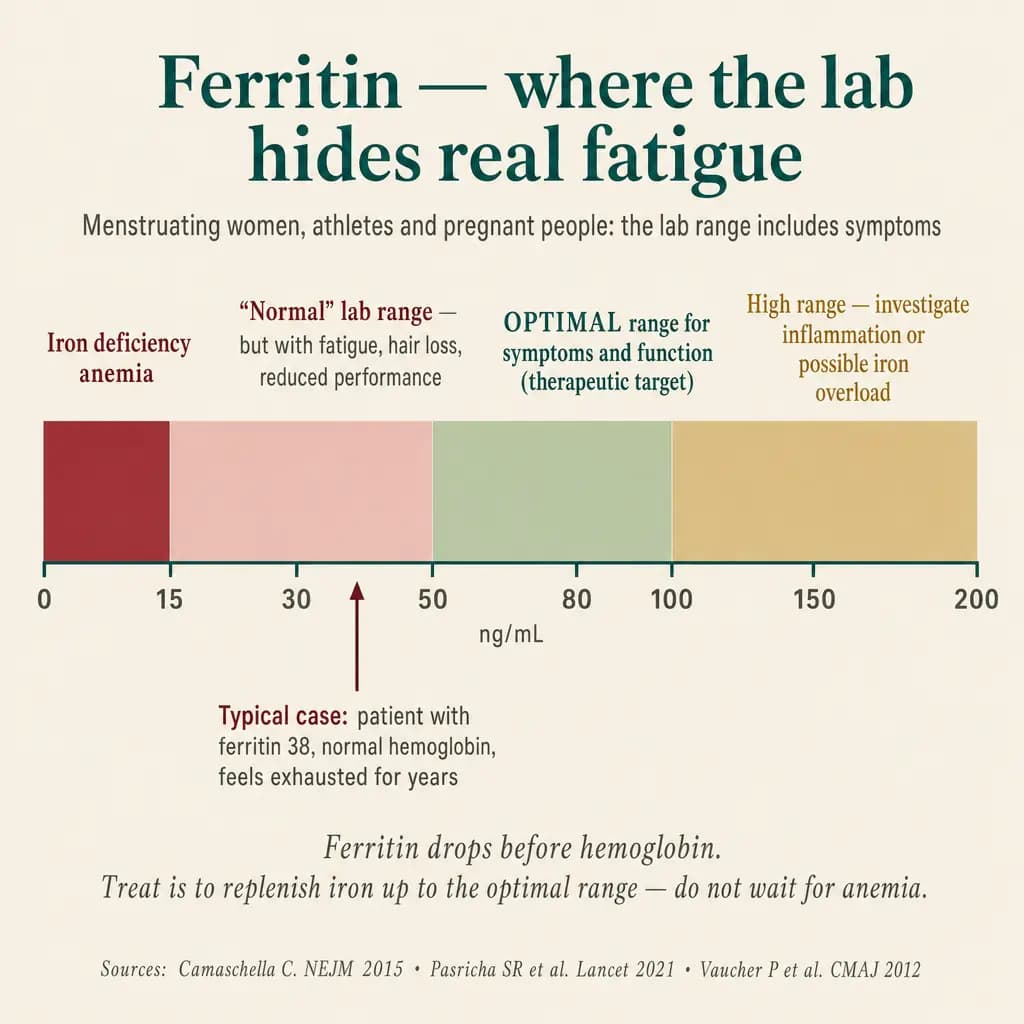
The clinical target, not the lab target
For an adult menstruating woman, or for any symptomatic adult, the useful clinical reading of ferritin our team applies is not the one on the label:
- Ferritin below 30 ng/mL — confirmed deficiency, even without anemia. Replace.
- Ferritin between 30 and 50 ng/mL with symptoms (fatigue, hair loss, exercise intolerance) — high probability of functional deficiency. Treat and reassess.
- Ferritin between 50 and 100 ng/mL — gray zone. Assess transferrin saturation. Saturation below 20% suggests deficiency despite the apparently "okay" ferritin.
- Therapeutic target for symptomatic women — usually ferritin between 80 and 100 ng/mL, with normal CBC and transferrin saturation between 25 and 45%.
A technical caveat is worth noting: ferritin is an acute-phase protein. In any inflammatory state — infection, autoimmune disease, obesity, last week's flu — it rises falsely. If the patient has ferritin 70 but elevated hs-CRP, deficiency may be masked. The team always reads ferritin alongside complete CBC, transferrin saturation, total iron-binding capacity, and CRP.
How to replace (and what not to do)
Oral replacement is the first line. Classical ferrous sulfate (40 to 65 mg elemental iron) works, but has a high rate of gastrointestinal intolerance — nausea, constipation, metallic taste. Patients who gave up on iron usually gave up because of that, not for lack of need.
Practical alternatives our team uses:
- Iron bisglycinate chelate — better tolerance, high bioavailability. Doses between 25 and 50 mg of elemental iron per day usually suffice in most symptomatic cases without anemia.
- Take with vitamin C (orange juice, kiwi, or 250 mg of ascorbic acid) — significantly increases absorption.
- Take fasting, away from coffee, tea, milk, calcium — each of those inhibits absorption by 40% or more.
- On alternate days — more recent research (Stoffel, 2017, in women) showed that every-other-day dosing absorbs more iron than daily dosing, because hepcidin rises after the first dose and blocks the next.
In some cases — malabsorption, persistent oral intolerance, chronic bleeding — intravenous replacement is indicated, today done in an outpatient protocol with ferric carboxymaltose or iron derisomaltose, in one or two infusions. It is safe, efficient, and in women with disabling fatigue and very low ferritin can change life within three to six weeks.
The cause needs to be investigated in parallel. If ferritin keeps falling despite replacement, or if the patient is a man or a postmenopausal woman, the first question is where the bleeding is — usually menstrual in women of reproductive age (menorrhagia), gastrointestinal tract in others (ulcer, diverticulum, neoplastic lesion). Replacing without investigating is treating a symptom and missing the underlying diagnosis.
What changed for Marcela
Initial ferritin 38, transferrin saturation 14%, hemoglobin 13.1, hs-CRP 0.4 (no inflammation). The team started iron bisglycinate 50 mg every other day, fasting, with vitamin C. Referral to gynecology to assess menorrhagia (which ended up indicating a hormonal IUD, which reduced flow to almost nothing).
Reassessment at 12 weeks: ferritin 86, saturation 32%, hemoglobin 13.8. Her sentence at the follow-up was the common one: I forgot what it was like to have energy. I thought it was age.
It was not age. It was two years of normal hemoglobin hiding a body working in economy mode.
The reading the Continuum makes
In Continuum Plenya, ferritin is not an isolated number on the panel. Through the ACTS Method (Activity, Alimentation & Smart Adjuncts · Clinical Optimization · Tending Mind, Body & Bonds · Sleep, Rhythm & Recovery), it enters alongside the menstrual cycle, body composition, training, sleep, hair loss. The gynecologist, the nutritionist, and the clinical team talk — because iron deficiency in a menstruating woman generally is not solved just by replacing iron. It is solved by also adjusting what is taking iron out of the system.
Endless fatigue in a 38-year-old woman is not motherhood. It is not the routine. It is, more frequently than is admitted, an operable symptom hidden behind the word normal.
References
- Krayenbuehl PA et al. Intravenous iron for the treatment of fatigue in nonanemic, premenopausal women with low serum ferritin concentration. Blood, 2011;118(12):3222-3227.
- Verdon F et al. Iron supplementation for unexplained fatigue in non-anaemic women: double blind randomised placebo controlled trial. BMJ, 2003;326(7399):1124.
- Vaucher P et al. Effect of iron supplementation on fatigue in nonanemic menstruating women with low ferritin: a randomized controlled trial. CMAJ, 2012;184(11):1247-1254.
- Pasricha SR, Tye-Din J, Muckenthaler MU, Swinkels DW. Iron deficiency. Lancet, 2021;397(10270):233-248.
Recognition
Does this text describe what you feel?
If so, it may be worth understanding how Continuum Plenya delivers this kind of care. Five short questions return a reading — or the team can listen to you directly.