Four professionals speaking the same language

TL;DR
Personal trainer, nutritionist, therapist, physician — separately, each does well what they do. Together, without coordination, they replicate the fragmentation that made conventional medicine ineffective for continuous care. Our integrated team at Plenya was built precisely to repair that gap.
The person arrives at our office with a sentence that repeats: I already have a personal trainer, a nutritionist, a therapist, and a physician — and even so I feel something is missing, someone putting it all together.
Our team observes, in patients we follow longitudinally, that this sentence is the symptom of a structural problem, not a personal one.
The fragmentation of medicine was replicated in premium care
The classical critique of conventional medicine is fragmentation: the cardiologist looks at the heart, the endocrinologist looks at the hormone, the orthopedist looks at the knee — and no one looks at the person. Each visit is an isolated event, with 15 minutes, no conversation between professionals, no reading of the whole.
The patient who could pay more left that model in the expected way: hired separate, premium professionals, each with more time and more listening. Gained in the quality of each interaction. Did not gain in integration.
Five years later, the complaint returns: the nutritionist asks for one thing, the trainer asks for another, the doctor has another hypothesis, the therapist works in parallel. I am in the middle, deciding between pieces of advice that sometimes contradict each other.
The fragmentation was replicated — only now expensive.
Four interdependent pillars
The premise of The ACTS Method (Activity, Alimentation & Smart Adjuncts · Clinical Optimization · Tending Mind, Body & Bonds · Sleep, Rhythm & Recovery) is simple and hard: the body does not work in parts. The interventions need to talk.
A concrete example our team sees recurrently. A patient comes in with a complaint of fatigue, weight stuck, anxiety rising. Looked at by each professional in isolation:
- The nutritionist sees the weight and adjusts the eating plan.
- The trainer sees the energy complaint and adjusts training.
- The physician sees the markers and adjusts medication.
- The therapist works on the anxiety.
Each intervention may be technically correct. But if the central problem is elevated cortisol from untreated chronic stress, the first three interventions row against the tide, and the fourth operates on a parallel register. No one is wrong. No one is coordinated.
The integrated reading our team applies would have seen that the bottleneck was the T pillar (Tending Mind, Body & Bonds) — and that while cortisol is high, weight does not budge, training fatigues more, and metabolic markers do not respond. The right intervention is to work the HPA axis first, and the other pillars follow.
That kind of reading only happens when the four are in the same room, on the same panel, talking.
The example the ebook brings
The case of Ana — the patient we describe in the book — illustrates this. Eighteen months of perfectly organized biochemistry (training, nutrition, supplementation, all the labs on point) and the CRP would not yield. The subclinical inflammation remained elevated, with no apparent metabolic cause.
The turn came when the psychologist entered the plan and treated the chronic anxiety that was there, normalized, behind everything. In three months, the CRP fell for the first time in a year and a half. The biochemical intervention had not failed — it had only been operating without the pillar that was missing.
Ana's sentence, at the closing visit: what changed was the pillar that was missing. That is the kind of reading isolated professionals almost never manage — and the kind our integrated panel surfaces by design.
What changes with integration
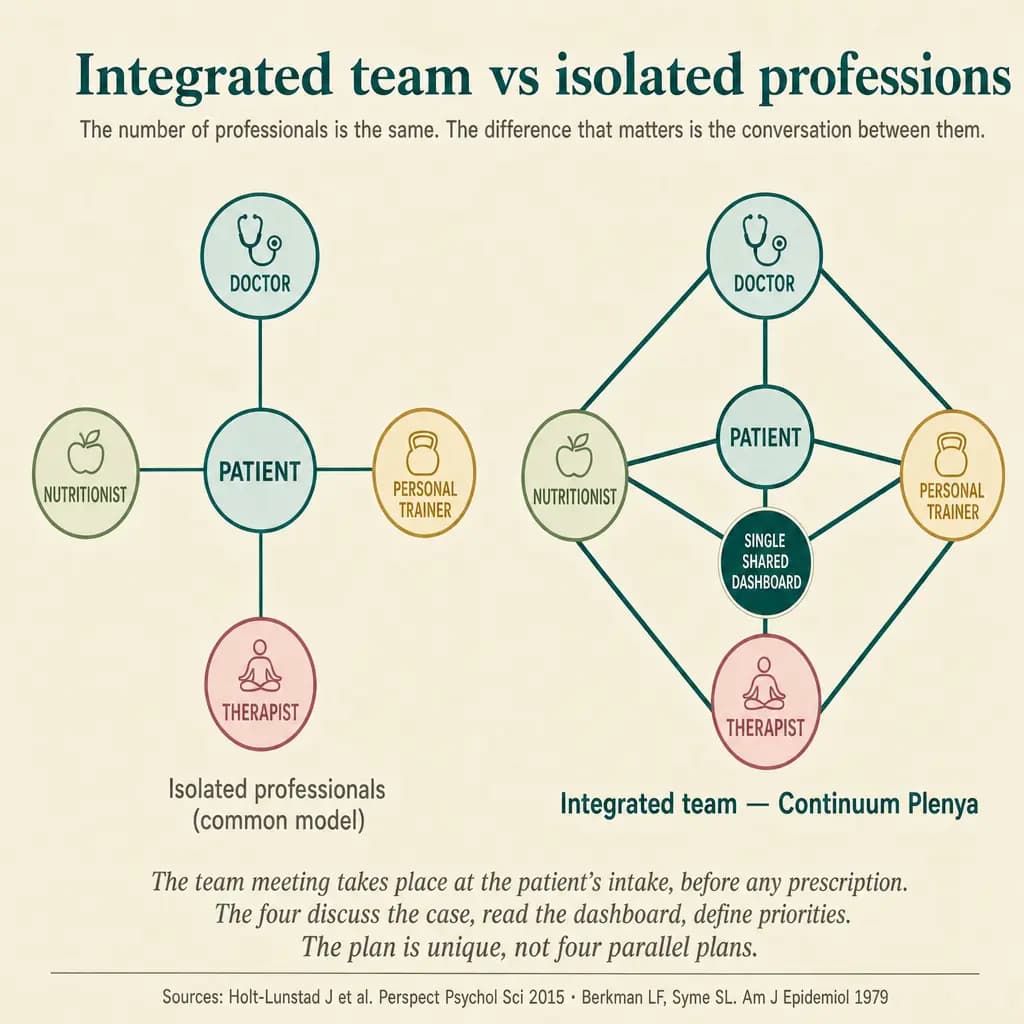
The operational difference of integrated care is not "more professionals." It is professionals talking.
In Continuum Plenya:
- The team meeting happens at patient entry, before any prescription.
- The four discuss the case, read the panel, define priorities.
- The plan is single, not four parallel plans.
- Every four weeks, the cycle completes — the patient passed through all the pillars in the month.
- When something changes — marker worsens, intervention does not respond, new symptom appears — the team realigns.
This is the opposite of "I have a doctor, a nutritionist, a trainer, and a therapist." It is the same number of professionals, with the difference that matters: they talk to each other about you.
Why this is hard to assemble on your own
The legitimate question is: why can't I just ask my four professionals to meet?
You can. But it rarely happens, for three reasons our team encounters again and again:
- Time — each professional has their own agenda; coordinating requires logistics no one has incentive to do.
- Language — without a shared method (ACTS, Plenya Score), each one reads in their own register. The meeting becomes juxtaposition, not integration.
- Continuity — one meeting solves a moment. Continuous care requires a structure that updates over time.
Continuum Plenya is that structure. The shared method, the cohesive team, the weekly cadence — all designed so the integration does not depend on the patient to organize it.
The sentence that matters
The difference between four professionals and a team is the conversation among them. Without that conversation, any arrangement replicates the fragmentation the premium patient was trying to leave behind.
With that conversation — the one the ACTS Method orchestrates — care finally begins to read the whole person.
References
- Holt-Lunstad J et al. Loneliness and Social Isolation as Risk Factors for Mortality: A Meta-Analytic Review. Perspect Psychol Sci, 2015;10(2):227-237.
- Berkman LF, Syme SL. Social Networks, Host Resistance, and Mortality. Am J Epidemiol, 1979;109(2):186-204.
- Attia P. Outlive: The Science and Art of Longevity. Harmony, 2023.
Recognition
Does this text describe what you feel?
If so, it may be worth understanding how Continuum Plenya delivers this kind of care. Five short questions return a reading — or the team can listen to you directly.