Medicine 2.0 vs. Medicine 3.0 — alarm or detector

TL;DR
The medicine that treated your father is not the medicine that will treat you. The difference lies in when it acts.
For our team at Plenya, the difference between Medicine 2.0 and Medicine 3.0 is the difference between a fire alarm and a smoke detector.
The alarm sounds when it is already burning. The detector sounds when the smoke begins.
Medicine 2.0 — the one we learned in school, the one practiced in most Brazilian offices — is built for act two. Treating established disease. Choosing the right drug, performing the right surgery, giving the right treatment at the moment everything is already happening.
Medicine 3.0 does not replace 2.0. Through The ACTS Method (Activity, Alimentation & Smart Adjuncts · Clinical Optimization · Tending Mind, Body & Bonds · Sleep, Rhythm & Recovery) we apply at Plenya, it adds act one. It looks for the smoke before the flame. It works with biomarkers that move five, ten, twenty years before the diagnosis — fasting insulin, ApoB, hs-CRP, homocysteine, VO₂ max, grip strength.
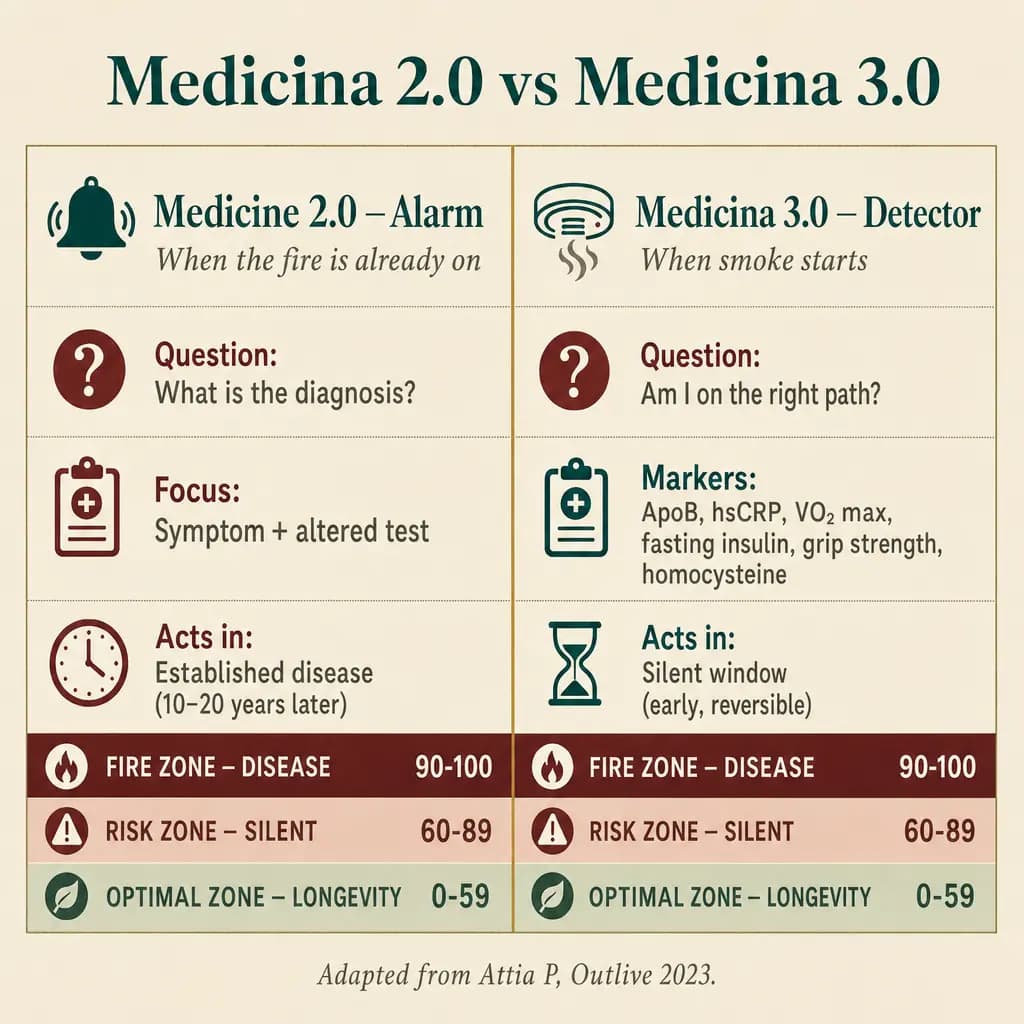
Each of these biomarkers has solid literature behind it. ApoB, according to the Sniderman and colleagues review in 2019 (JAMA Cardiology), predicts atherosclerotic risk better than LDL-C because it measures the actual count of atherogenic particles — and begins to drift before total cholesterol moves. VO₂ max, in the Mandsager study (JAMA Netw Open 2018), is the most powerful prognostic marker of all-cause mortality ever studied — stronger than smoking. The American Heart Association (Ross 2016) argues that cardiorespiratory fitness should be treated as a vital sign. hs-CRP, along the line of Ridker's CANTOS trial (NEJM 2017), connects subclinical inflammation to hard cardiovascular endpoints.
Ricardo, 52, had an annual checkup. Every test "normal." Almost died of a heart attack in a parking lot. None of the six markers that were outside the optimal range appeared on the conventional panel. The alarm only sounded once the fire had already started.
The question that matters, in our team's reading, is not "do I have a disease?" It is: "am I on its path?"
Excerpt from Chapter 1 of the book BEFORE — The silent window between normal and optimal — a decade where health is decided.
References
- Sniderman AD, Thanassoulis G, Glavinovic T, et al. "Apolipoprotein B Particles and Cardiovascular Disease: A Narrative Review." JAMA Cardiol. 2019;4(12):1287-1295.
- Mandsager K, Harb S, Cremer P, et al. "Association of Cardiorespiratory Fitness With Long-term Mortality Among Adults Undergoing Exercise Treadmill Testing." JAMA Netw Open. 2018;1(6):e183605.
- Ridker PM, Everett BM, Thuren T, et al. "Antiinflammatory Therapy with Canakinumab for Atherosclerotic Disease." N Engl J Med. 2017;377(12):1119-1131.
- Ross R, Blair SN, Arena R, et al. "Importance of Assessing Cardiorespiratory Fitness in Clinical Practice: A Scientific Statement From the American Heart Association." Circulation. 2016;134(24):e653-e699.
- Amaral Filho GJM. "ANTES — A Janela Silenciosa entre o Normal e o Ótimo." 2026, ISBN 978-65-02-06742-0.