The silent window between normal and optimal

TL;DR
There is a ten- to twenty-year interval in which serious disease assembles itself without showing up on routine labs. It is in that interval that longevity is built — or lost.
The lab says “normal.” The body says: I have been falling ill for eight years and no one is looking.
There is an interval between what the lab can call disease and what the body can call full health. That interval has no name in conventional practice. In our clinical work at Plenya, we call it the silent window.
The silent window is not a metaphor. It is a measurable period — between ten and twenty years — in which cardiovascular, metabolic, neurodegenerative, and oncologic disease assembles itself in silence, with routine labs sitting comfortably within range and the patient reporting no complaint.
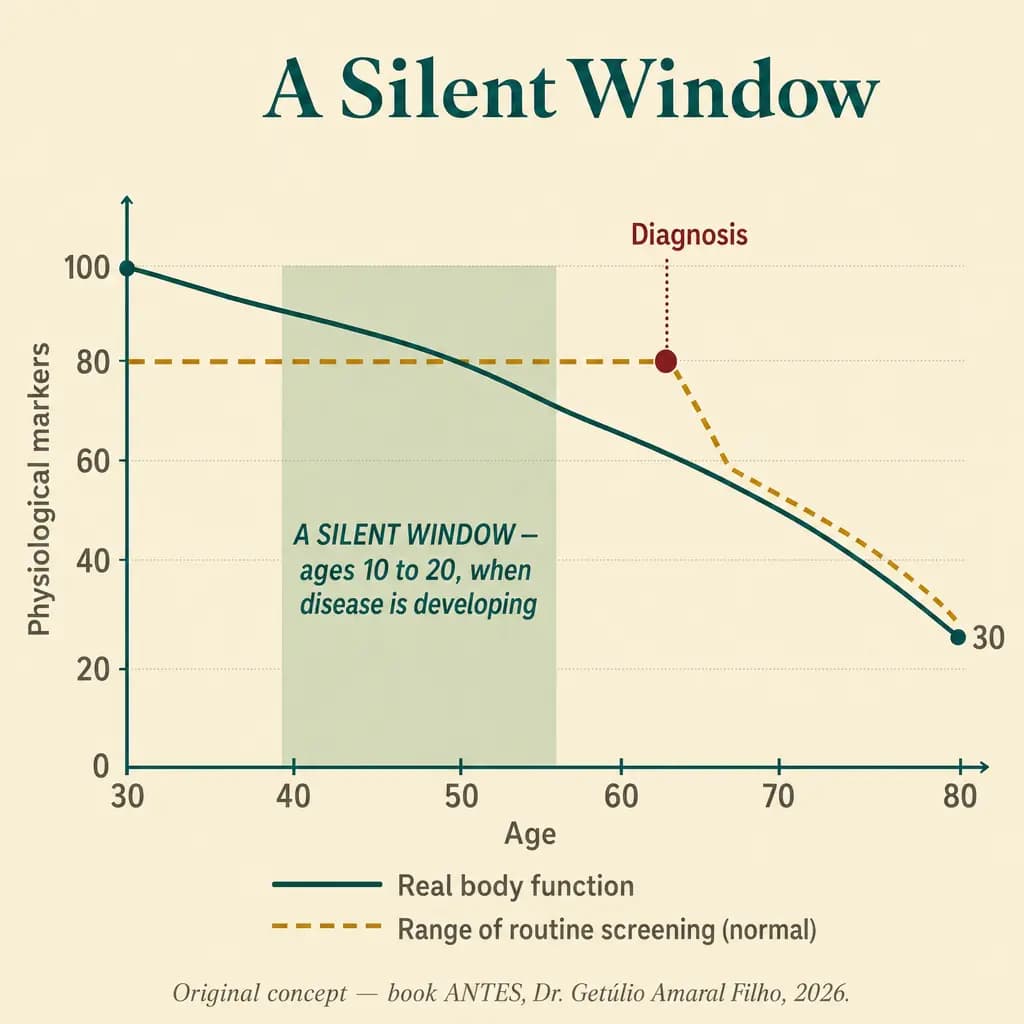
This reading is anchored in solid literature. Sniderman and colleagues in their 2019 review (JAMA Cardiology) showed that ApoB — the actual count of atherogenic particles — begins to move years before any change in the conventional lipid profile. Khera and colleagues in 2018 (Nature Genetics) demonstrated that polygenic risk scores can identify individuals carrying risk equivalent to monogenic mutations — decades before the first event. And the American Heart Association statement (Ndumele 2023) consolidates the picture: heart, kidney, and metabolism deteriorate as a coupled system, along a single axis, well before the diagnosis arrives.
Peter Attia, in Outlive (2023), formalized the same clinical intuition in language for the patient: the time to intervene is before the diagnosis — not after. It is an agenda that fits what our team applies through The ACTS Method (Activity, Alimentation & Smart Adjuncts · Clinical Optimization · Tending Mind, Body & Bonds · Sleep, Rhythm & Recovery).
The difference between intervening within that window and intervening after the diagnosis is the difference between building longevity and managing morbidity.
The medicine we practice at Plenya seeks that interval. Not as an alternative to conventional medicine. As an extension of it — backward in time, before established disease takes hold.
It begins before.
Excerpt adapted from the Introduction of the book BEFORE — The silent window between normal and optimal — a decade where health is decided.
References
- Attia P, Gifford B. "Outlive: The Science and Art of Longevity." Harmony Books, 2023. ISBN 978-0593236598.
- Sniderman AD, Thanassoulis G, Glavinovic T, et al. "Apolipoprotein B Particles and Cardiovascular Disease: A Narrative Review." JAMA Cardiol. 2019;4(12):1287-1295.
- Khera AV, Chaffin M, Aragam KG, et al. "Genome-wide polygenic scores for common diseases identify individuals with risk equivalent to monogenic mutations." Nat Genet. 2018;50(9):1219-1224.
- Ndumele CE, Rangaswami J, Chow SL, et al. "Cardiovascular-Kidney-Metabolic Health: A Presidential Advisory From the American Heart Association." Circulation. 2023;148(20):1606-1635.
- Amaral Filho GJM. "ANTES — A Janela Silenciosa entre o Normal e o Ótimo." 2026, ISBN 978-65-02-06742-0.