Supplementation after 40: what makes a difference

TL;DR
Roberto, 52, arrived with a bag of seventeen bottles and the right question: which of these is actually doing anything? Four substances have robust evidence for adults over 40, and the indication of each comes out of clinical assessment, not from fashion.
Our team sees cases like Roberto's regularly. He is 52, an engineer, measures everything. He came with a bag (literally, a pharmacy bag) containing seventeen bottles. Doctor, I spend a fortune a month. But I don't know if any of this is doing anything.
Our team asked for his recent labs. Vitamin D at 22 ng/mL, below the sufficiency range. Serum magnesium 1.7 mg/dL, at the floor of the "normal" range, which says little because serum magnesium underestimates tissue deficiency. Creatine, he had never taken. I thought it was just for the gym.
Roberto is the common case we see. It is not a lack of care, it is care without direction. Useful supplementation is the one designed from labs and clinical assessment, with substance and dose by name, reassessed methodically.
The core with clinical evidence
The supplementation literature for adults over 40 is vast. When filtered by randomized trials of reasonable size, with clinically relevant endpoints, the core that survives is short: creatine monohydrate, omega-3 (EPA+DHA, or pure EPA at high dose for specific indications), vitamin D in the deficient (together with K2), magnesium in the deficient or in specific conditions. That is the base set we work with. Other substances enter in their own clinical situations, within the same lab-guided reasoning.
Creatine: the most underestimated
Creatine monohydrate is probably the supplement with the best evidence-to-price ratio ever studied. It was stigmatized for decades as "gym stuff" and is being rediscovered in the longevity clinic for the right reason.
The Chilibeck and colleagues meta-analysis, published in 2017 in the Open Access Journal of Sports Medicine, aggregated 22 randomized trials in adults aged 57 to 70 on average. The creatine + strength training group gained on average 1.37 kg (3 lbs) more lean mass than the placebo + training group, with significant gains in bench press and leg press strength. The effect happens with 3 to 5 g/day, no loading phase, no cycling. The specific literature shows no kidney harm in people with normal renal function.
More recently: data suggest additional benefit in cognition and mood in older adults, especially during periods of sleep deprivation or stress. Muscle is the body's largest creatine store, but the brain also uses it, and the passage across the blood-brain barrier explains the neurocognitive effect.
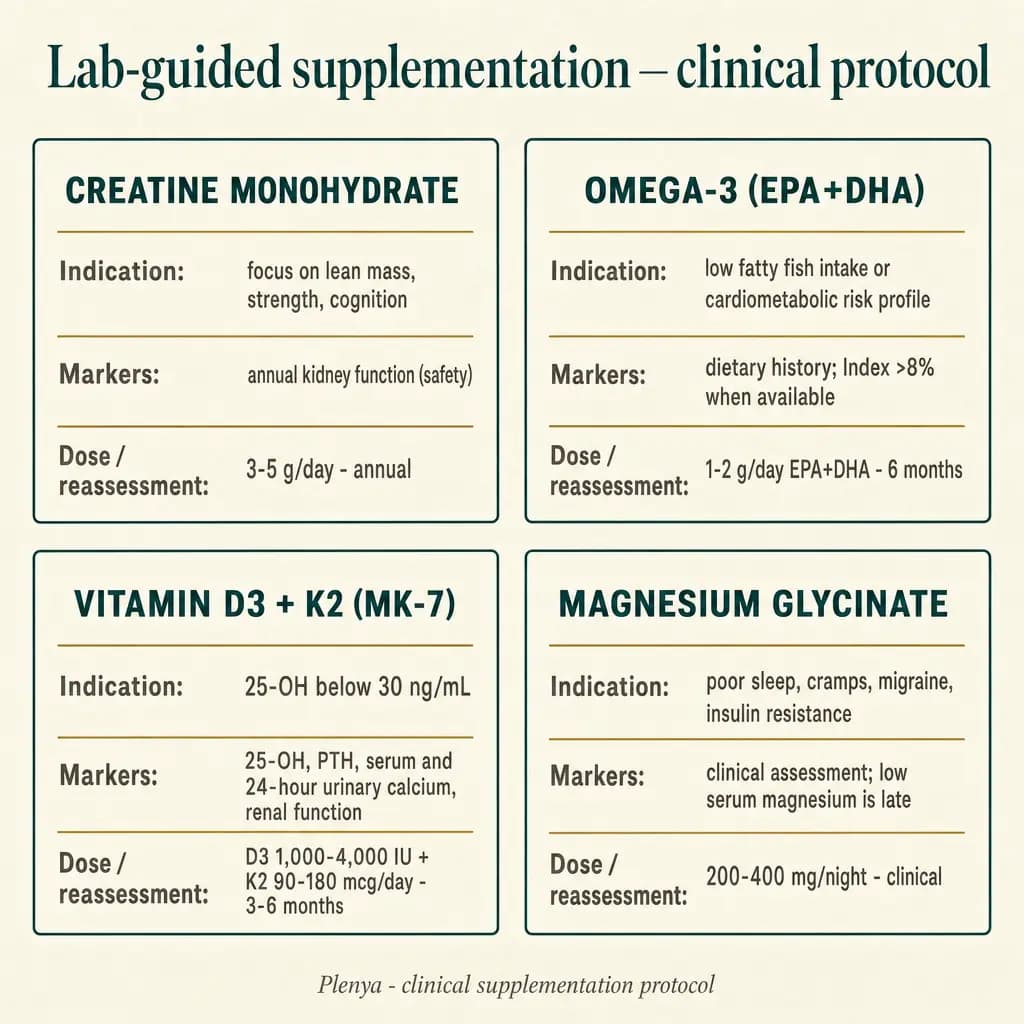
Practical indication: 3-5 g/day of creatine monohydrate (standard or micronized form). Taken consistently, every day, with or without training.
Omega-3: what matters is the indication
The VITAL trial, published by JoAnn Manson and colleagues in 2019 in the NEJM, randomized more than 25,000 adults to 1 g/day of fish oil or placebo, with five-year follow-up. There was no statistically significant reduction in the composite primary cardiovascular endpoint in the general population without specific indication.
The picture changes with indication. REDUCE-IT, conducted by Deepak Bhatt and also published in 2019 in the NEJM, randomized 8,179 patients with elevated triglycerides (150-499 mg/dL) already on statin to receive icosapent ethyl (pure EPA, high dose of 4 g/day) or placebo. A 25% reduction in major cardiovascular events. Dose, purity, and indication matter.
The Yang Hu, Frank Hu, and Manson meta-analysis, published in the Journal of the American Heart Association in 2019, aggregating 13 trials and 127,000 participants, showed a modest but significant reduction in cardiovascular mortality with marine omega-3 supplementation, with a more consistent effect in EPA formulations than in low-dose mixed EPA+DHA formulas.
How we decide, in practice. The starting point is a dietary history: people who eat fatty fish (sardine, salmon, tuna, mackerel) two or three times a week, on average, reach adequate intake and generally do not need supplementation. For others, or in those whose cardiometabolic profile calls for attention (elevated triglycerides, metabolic syndrome, prior cardiovascular event, early family history), supplement combined EPA+DHA around 2 g/day, with a certified formulation (IFOS seal or equivalent).
The Omega-3 Index erythrocyte test (HS-Omega-3 Index) is a useful tool to individualize the target (>8%) and measure response, but it is available mainly in reference laboratories in capital cities and is not covered by most health plans. When access is available, it improves the decision; when not, the decision is clinical, based on dietary intake, risk profile, and therapeutic response. In patients with established cardiovascular disease and elevated triglycerides, the conversation belongs with the cardiologist: higher dose, pure EPA, individual decision.
Vitamin D and vitamin K2: the pair that works together
Vitamin D supplemented blindly, without prior measurement, in an adult without deficiency, prevents nothing — that is what VITAL showed, with 2,000 IU/day of D3 against placebo in a general population. In people with deficiency, the story is different.
Replacement makes sense when deficiency is confirmed (25-OH-vitamin D below 30 ng/mL), a common situation in Brazil among those who work indoors. The reasonable target is 40 to 60 ng/mL, and the dose to reach it varies (1,000 to 4,000 IU/day in most cases). The definition is by blood, not by guess, and it is not only the starting dose: it is the adjustment over time.
How we adjust the dose, in practice. Following only 25-OH-vitamin D is incomplete, because it measures the reservoir, not the functional state. In our assessment, we integrate:
- 25-OH-vitamin D (reservoir): target 40-60 ng/mL.
- PTH (parathyroid hormone): when elevated, it signals that the body "is asking for" more vitamin D even if 25-OH looks adequate. PTH falling with replacement is one of the best markers that the dose has reached the functional band.
- Serum calcium and 24-hour urinary calcium: ensure safety of replacement, especially at higher doses or in patients with altered renal function.
- Renal function and phosphate: context, especially in patients with chronic kidney disease.
With these variables together, the dose is titrated to reach the 25-OH target band with PTH normalizing, without hypercalciuria. Reassessment every 3 to 6 months until stable, then annually. The Endocrine Society Guideline (Holick et al., 2011) and the subsequent nephrology literature give the framework for this integrated approach.
Why K2 enters alongside. Vitamin D increases intestinal calcium absorption. Vitamin K2 (MK-7 form) is the cofactor that directs that calcium to the right place: it activates osteocalcin, the protein synthesized by the osteoblast that binds calcium to the bone matrix, and it activates matrix Gla protein in the vessels, which acts in the opposite direction to vascular calcification. In other words, replacing vitamin D without adequate K2 is opening the calcium tap without defining the destination. The Knapen and colleagues trial, published in 2013 in Osteoporosis International, showed that 180 µg/day of MK-7 over 3 years significantly reduced bone loss in postmenopausal women. The cardiovascular evidence is still in construction, but the bone benefit is what sustains the indication. In our practice, vitamin D and K2 (MK-7) are prescribed together in most replacement cases, at doses of 90 to 180 µg/day of MK-7.
Magnesium: the silent one
The DiNicolantonio and colleagues review in Open Heart (BMJ) in 2018 synthesized the problem: average intake in Western populations is below the RDA (310-420 mg/day), serum magnesium only falls after tissue stores are already depleted, and deficiency is associated with hypertension, insulin resistance, arrhythmias, migraines, and poor sleep quality.
Practical indication: typical replacement dose 200-400 mg/day of elemental magnesium, in absorbable forms. Glycinate works best for sleep and anxiety. Citrate has good absorption, but may have a laxative effect at higher doses. Threonate crosses the blood-brain barrier with emerging cognition data. The absorbable forms make a practical difference compared to oxide.
Substances with contextual indication
Some substances enter in specific clinical situations, within the same lab-guided reasoning:
- In a patient with mild-to-moderate osteoarthritis who already hits the daily protein target and maintains a specific joint complaint, hydrolyzed collagen shows modest benefit in pain and function and is a reasonable choice.
- In an older adult with restricted intake, important dietary restriction, malabsorption, or a post-bariatric patient, multivitamin enters as coverage for micronutrients not derived from diet.
- After recent antibiotic use or in a specific functional gut condition, probiotics with a targeted strain and defined duration help — not as perpetual maintenance.
- In chronic joint pain where continuous NSAID use needs to be avoided, curcumin with absorption carrier (piperine, liposomal, or phytosomal) has signal and enters as an adjuvant.
- As a glutathione precursor, N-acetylcysteine (NAC) has applications in pulmonology, hepatology, and selected clinical contexts.
- In a patient on statin with significant myalgia, in specific cardiology cases, or in a metabolic phenotype that calls for it, coenzyme Q10 (ubiquinol) is considered, with heterogeneous data that require individualized reading.
- In elevated LDL, constipation, or glycemic control that diet does not cover, soluble fibers (psyllium, oat beta-glucan) complement what is missing on the plate.
- B12, zinc, selenium, iodine, and iron enter as targeted replacements by lab work in specific populations (vegetarians, elderly, chronic users of metformin or PPI, deficient regions, thyroid context), and they are already part of the initial assessment panel.
In all of these situations, the same structure that governs the core applies: clear clinical indication, considered dose, trustworthy brand, reassessment interval.
The reading the Continuum makes
Through The ACTS Method (Activity, Alimentation & Smart Adjuncts · Clinical Optimization · Tending Mind, Body & Bonds · Sleep, Rhythm & Recovery) we apply, Continuum Plenya does not sell supplements, has no store counter, has no affiliation. The supplementation list is designed based on specific labs: 25-OH-vitamin D, PTH, serum and urinary calcium, magnesium (serum and sometimes intracellular), ferritin, B12, homocysteine, lipid profile, triglycerides, and (when available) Omega-3 Index. The recommendation is nominal: the substance, the dose, the trustworthy brand, the reassessment interval. Roberto, from the beginning, today takes four things and a vitamin K2 alongside the D. For the first time, I know why for each one.
Useful supplement is the one with clear clinical indication, dose thought through by lab work, and a reassessment interval.
References
- Chilibeck PD et al. Effect of creatine supplementation during resistance training on lean tissue mass and muscular strength in older adults: a meta-analysis. Open Access J Sports Med, 2017;8:213-226.
- Bhatt DL et al. Cardiovascular Risk Reduction with Icosapent Ethyl for Hypertriglyceridemia. N Engl J Med, 2019;380(1):11-22.
- Hu Y, Hu FB, Manson JE. Marine Omega-3 Supplementation and Cardiovascular Disease: An Updated Meta-Analysis of 13 Randomized Controlled Trials Involving 127 477 Participants. J Am Heart Assoc, 2019;8(19):e013543.
- Manson JE et al. Vitamin D Supplements and Prevention of Cancer and Cardiovascular Disease. N Engl J Med, 2019;380(1):33-44.
- Holick MF et al. Evaluation, Treatment, and Prevention of Vitamin D Deficiency: an Endocrine Society Clinical Practice Guideline. J Clin Endocrinol Metab, 2011;96(7):1911-1930.
- Knapen MHJ, Drummen NE, Smit E, Vermeer C, Theuwissen E. Three-year low-dose menaquinone-7 supplementation helps decrease bone loss in healthy postmenopausal women. Osteoporos Int, 2013;24(9):2499-2507.
- DiNicolantonio JJ, O'Keefe JH, Wilson W. Subclinical magnesium deficiency: a principal driver of cardiovascular disease and a public health crisis. Open Heart, 2018;5(1):e000668.