The sleep that doesn't restore

TL;DR
Sleeping seven hours and waking exhausted is not a lack of discipline or "a phase." It is a signal — usually of underdiagnosed apnea, fragmented sleep, or absence of deep sleep. And it is investigable.
In our clinical practice at Plenya, the complaint is not unusual. Doctor, I sleep seven, eight hours. I wake up dead. The first clinical reaction is usually to reassure: it's stress, it's a phase. The second is to prescribe sleep hygiene — avoid screens at night, go to bed early.
Almost always, the investigation stops there. And the patient stays exhausted for a few more years.
Time in bed is not sleep
The central confusion is between time lying down and effective sleep. They are different things. You can spend eight hours in bed and:
- have long latency (take a long time to fall asleep),
- wake up several times without realizing (micro-arousals),
- not reach enough deep sleep (N3),
- have truncated REM cycles.
In any of those scenarios, time in bed is wasted. The functional result — metabolic restoration, cognitive consolidation, hormonal regulation — does not happen.
And you wake up exhausted, thinking you slept well.
The apnea no one investigates
The most underdiagnosed cause of non-restorative sleep in adults is obstructive sleep apnea. Conservative estimates: 70 to 80% of cases are not detected. In Brazil, the EPISONO study (Tufik et al., Sleep Medicine, 2010), conducted on a population sample in São Paulo, found obstructive apnea in 32.8% of the city's adults, most of them without prior diagnosis. The classical profile — obese man, scandalous snoring, daytime sleepiness — captures only part of the iceberg.
Our team observes a silent profile. A person with normal weight or slightly above. Moderate snoring. No obvious daytime sleepiness. Wakes at night to use the bathroom (a micro-arousal disguised as “going to the bathroom”). Has diffuse fatigue. Cognition fluctuates. Libido falling. Blood pressure rising.
That profile is almost never referred for polysomnography because the standard protocol requires marked daytime sleepiness to suspect.
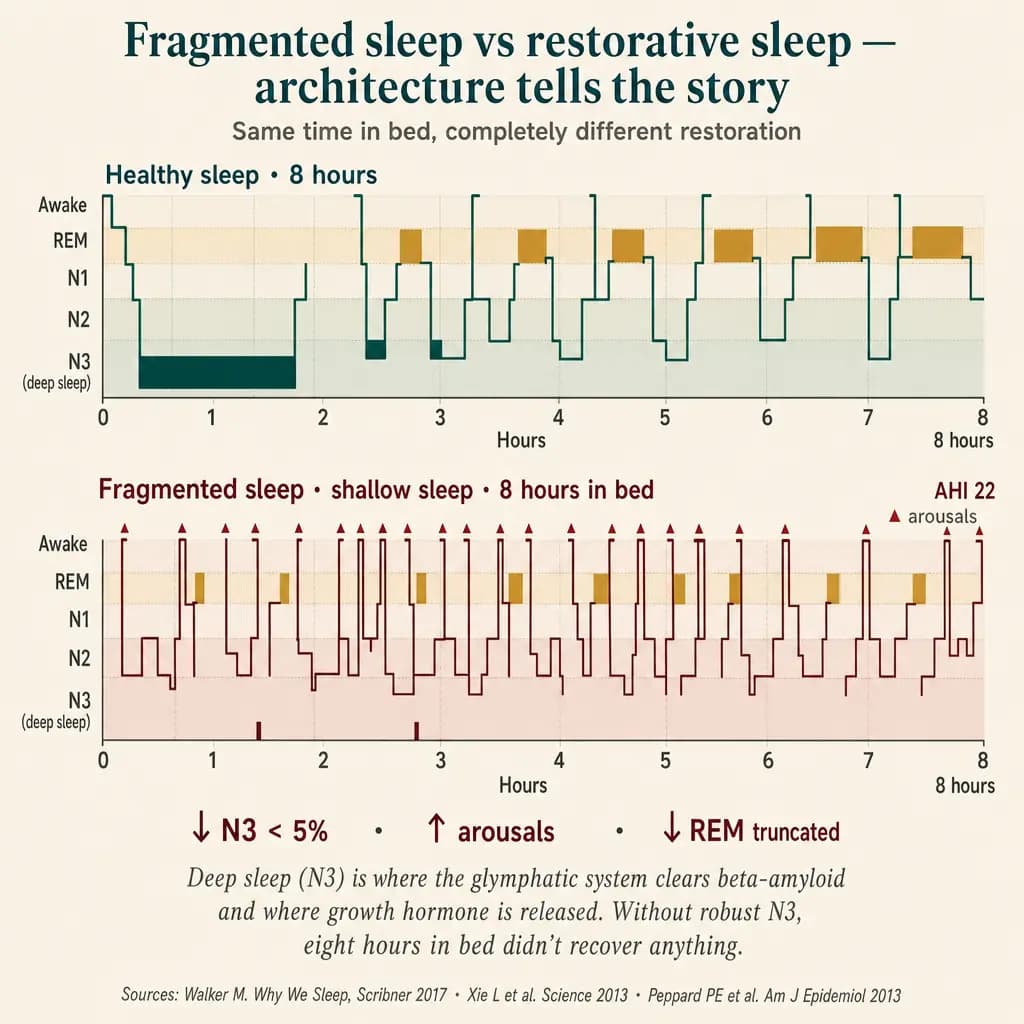
When we order polysomnography in this patient: AHI (apnea-hypopnea index) of 15 to 25. Deep sleep below 5%. The whole picture was apnea.
The intervention — usually CPAP, or alternatives depending on anatomy — reverses fatigue, libido, cognition, and blood pressure within months. Cardiovascular markers improve. Testosterone rises. The patient says: I didn't know good sleep was this.
Deep sleep is where repair happens
There is a hierarchy in sleep stages. The most important for restoration are:
N3 (deep sleep) — where growth hormone is released and where declarative memory consolidates (Diekelmann & Born, Nat Rev Neurosci, 2010). In animal models, it is also the phase in which the glymphatic system shows increased clearance of cerebral metabolites, including proteins relevant to neurodegenerative disease (Xie et al., Science, 2013). How much this translates quantitatively to humans remains under research, but the mechanism provides a rationale for what is observed clinically: N3 deprivation associates with poorer cognition. In a healthy adult, N3 represents 15–25% of the night. In someone with apnea, significant fragmentation, or alcohol before bed, it falls to 5% or less.
REM — dream sleep, where emotional memory is processed and consolidated. Typically happens in growing cycles across the night. Truncating the end of the night (waking three hours before expected) costs REM disproportionately.
The difference between a “decent” night and a restorative night is the robust presence of those two phases. Without instruments, it is almost impossible to know whether they are happening.
What silently steals deep sleep
The most common thieves we identify:
- Evening alcohol — eases sleep onset and gives a misleading sense of "passing out." Suppresses REM and produces marked fragmentation in the second half of the night, with early awakenings and shallow sleep. Total time preserved, quality wrecked. Two glasses of wine at dinner are enough for the effect.
- Apnea — fragments the structure, prevents reaching N3.
- Gastroesophageal reflux — micro-arousals the patient does not recall.
- Environment — temperature above 19–20°C (66–68°F), indirect light, background noise.
- Elevated nighttime cortisol — unregulated stress keeps the sympathetic system active, hindering depth.
- Caffeine after noon — typical half-life of 3 to 5 hours, extending to 7–9 hours in slow metabolizers. For a significant fraction of adults, the 2 p.m. coffee is still circulating at 10 p.m.
Each of these factors is addressable when identified. What is missing, in general, is someone with the time to map them.
The most underestimated intervention
It is not melatonin. It is not full blackout. It is morning light — direct sun in the eyes within the first 30 to 60 minutes after waking.
Strong morning light exposure adjusts the circadian rhythm and increases sleep pressure at night, improving latency and depth. It is the intervention that most often responds, generally in two weeks, at no cost.
Most patients have never been instructed to do it.
How Continuum Plenya approaches the S pillar
The S pillar (Sleep, Rhythm & Recovery) cuts across the entire program. Through The ACTS Method (Activity, Alimentation & Smart Adjuncts · Clinical Optimization · Tending Mind, Body & Bonds · Sleep, Rhythm & Recovery) we apply, on entry our team performs:
- Structured sleep assessment (validated questionnaires, chronotype pattern, apnea symptoms).
- Polysomnography when the panel suggests apnea or other sleep dysfunction.
- Analysis of modulating factors (alcohol, caffeine, environment, light exposure).
- Adjustment of the weekly plan to protect deep sleep (light routine, schedules, evening eating).
Each cycle, sleep is reassessed. When something regressed — traveled, changed time zones, returned to evening drinking — the adjustment happens in the visit before becoming cumulative liability.
The sentence that matters
Sleep is not rest. It is clinical operation. And “I'm tired even sleeping” is an operable symptom — not a condition of modern adult life.
The right question is not do I sleep enough? It is is the sleep I have happening in the right phases, at the right quality, with measurable restoration?
To answer, you need to measure. To measure, you need method. And to correct, you need continuity.
References
- Tufik S, Santos-Silva R, Taddei JA, Bittencourt LRA. Obstructive sleep apnea syndrome in the São Paulo Epidemiologic Sleep Study. Sleep Med, 2010;11(5):441-446.
- Peppard PE et al. Increased Prevalence of Sleep-Disordered Breathing in Adults. Am J Epidemiol, 2013;177(9):1006-1014.
- Diekelmann S, Born J. The memory function of sleep. Nat Rev Neurosci, 2010;11(2):114-126.
- Xie L et al. Sleep Drives Metabolite Clearance from the Adult Brain. Science, 2013;342(6156):373-377.
Recognition
Does this text describe what you feel?
If so, it may be worth understanding how Continuum Plenya delivers this kind of care. Five short questions return a reading — or the team can listen to you directly.