What the annual checkup does not show about your heart

TL;DR
Half of all heart attacks happen in people with a "normal" checkup the year before. The problem is not negligence — it is that the routine exam was designed to detect obstruction, and the real disease is something else.
The question is uncomfortable, but our team believes it needs to be asked: why is half of all heart attacks the first clinical manifestation of the disease? Why do so many “healthy” people drop without warning?
It is not lack of care. It is lack of tool.
What the traditional checkup is for
The basic lipid profile — total cholesterol, HDL, LDL, triglycerides — was consolidated in the 1980s as cardiovascular disease screening. It worked for entire generations of medicine. It remains useful. But, in our reading, it is insufficient.
What it does well: identify people with grossly elevated cholesterol and justify intervention. What it does poorly: capture the patient whose disease is silently building with “normal” cholesterol.
And that population, our team observes, is large.
What the test does not see
Coronary disease is a process of decades. It begins with inflammation in the arterial wall, continues with infiltration of ApoB-carrying particles loaded with cholesterol, evolves into plaque, calcifies, eventually ruptures, and produces the event.
The routine exam measures the cholesterol circulating in the blood. It does not measure:
- How many particles are circulating (ApoB) — a person with “normal” LDL can have a high particle count, and the number of particles is what actually enters the wall.
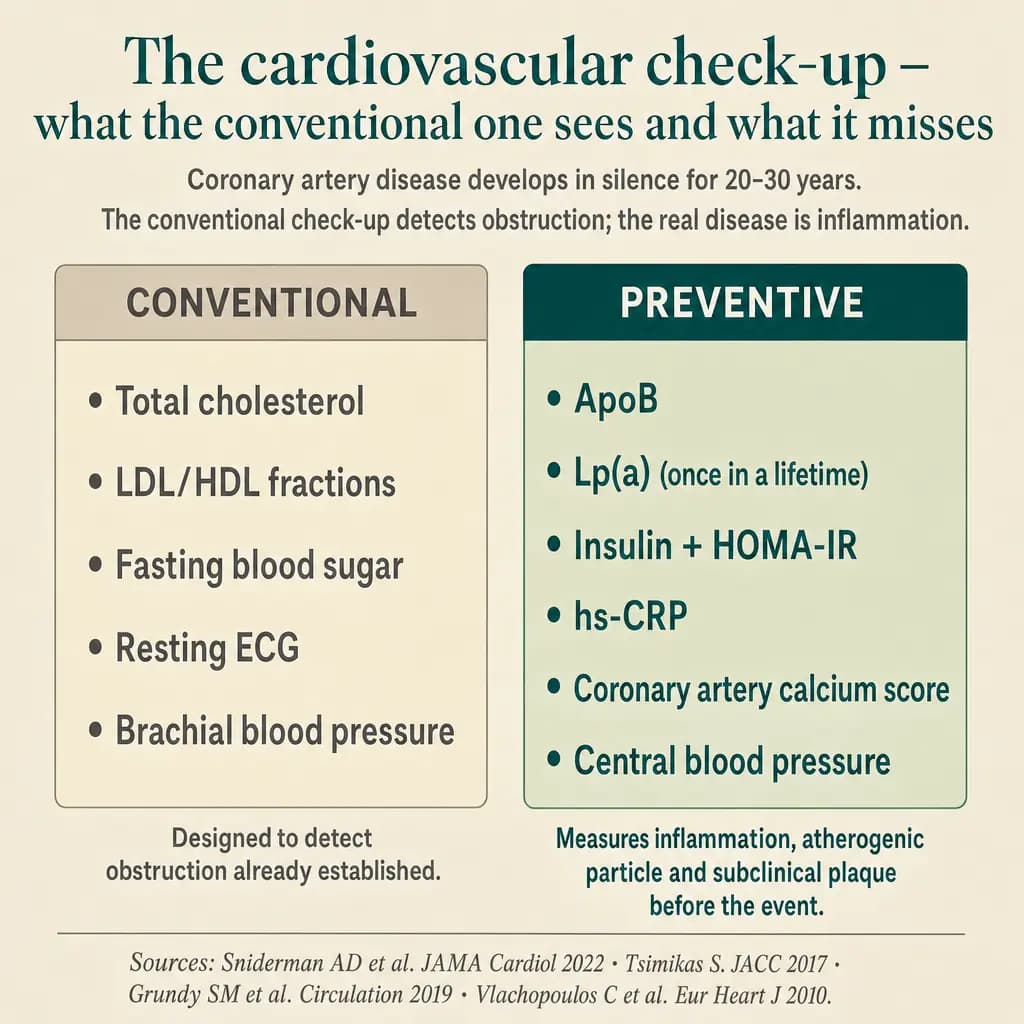
- Lp(a), a particle of genetic origin that doubles risk in 20% of the population. Measured once in a lifetime — and almost no one orders it.
- hs-CRP — high-sensitivity C-reactive protein, which reflects subclinical inflammation. Inflammation is the backdrop of the atherosclerotic process.
- Coronary calcium score — a quick CT that shows, in image, how much calcified plaque already exists in the coronaries. There is no substitute for that information.
- Central blood pressure, distinct from arm pressure — more correlated with cardiovascular outcomes.
- Post-prandial glucose and fasting insulin — because insulin resistance is an independent factor for coronary disease, even with normal fasting glucose.
Each of these data points, alone, does not decide. The set, read by a team that knows what they are looking at, completely redraws the risk calculation.
The case of the statin without imaging
A common scene we receive: patient on a statin for six years, LDL “controlled,” physician reassures. Our team orders the calcium score. Result: 412.
A score of 412 indicates advanced atherosclerotic disease. The statin helped — but the plaque was there before, and no one saw it. The patient spent six years thinking they were “well cared for” because a number was controlled, without ever having seen an image of their own coronaries.
This is not rare. In our experience, it is the rule for those who use only lipids as a tool.
What changes when you measure what matters
The preventive cardiovascular medicine of this decade — and what our team applies through The ACTS Method (Activity, Alimentation & Smart Adjuncts · Clinical Optimization · Tending Mind, Body & Bonds · Sleep, Rhythm & Recovery) — has three central moves:
- Replace LDL with ApoB as the primary measure of atherogenic particles.
- Order Lp(a) once to identify the segment with elevated genetic risk.
- Use imaging (calcium score or CT angiography) when the intermediate risk calculation does not allow a clear decision.
These are simple interventions, inexpensive (at scale), and they change management. But they require someone to order, read, and cross-reference. They are not in the standard protocol — they are in ours.
How Continuum Plenya approaches the cardiovascular axis
In our program, the C pillar (Clinical Optimization) is not “checking cholesterol once a year.” It is:
- Expanded panel on entry (ApoB, Lp(a), hs-CRP, full lipid panel, glucose + insulin + HbA1c).
- Imaging when indicated to decide management — calcium score is the most common starting point.
- Quarterly reassessment of markers that respond to intervention.
- Integrated management: what the nutritionist prescribes, what the exercise physiologist designs, what the psychologist works on — everything talks to what the panel shows.
The patient leaves knowing where they are, on which trajectory, and what each clinical decision is moving. It is not “take the medication and come back in a year.” It is you and our team reading the same map, adjusting together.
Anticipating is not anxiety
Ordering the right tests is not hypochondria. It is, in our reading, recognizing that the window in which the result can be moved is before the event, not after. Cardiovascular disease begins between 25 and 35 years old. The symptom arrives between 50 and 70. The useful window is the one in the middle — and that is exactly where Continuum Plenya operates.
The central sentence of modern preventive medicine, and what guides our team: health is not about reacting. It is about anticipating. For the heart, that is literal.
References
Recognition
Does this text describe what you feel?
If so, it may be worth understanding how Continuum Plenya delivers this kind of care. Five short questions return a reading — or the team can listen to you directly.