When "all normal" is not enough

TL;DR
The lab "within range" answers an important question — do you have diagnosed disease? But it does not answer the right question, which is what trajectory you are on.
The sentence shows up in nearly every first visit our team receives. "Doctor, I had a checkup four months ago, everything is normal — but I feel it isn't." The person is not delirious. They are perceiving something the exam was not designed to show.
The question the reference range answers
The “normal” range of a lab answers a specific and legitimate question: is this result statistically close to the average of people of similar age and sex?
That is a useful filter for diagnosing established disease. It is terrible for detecting trajectory.
Because the “average” of the Brazilian population at 45 includes sedentary behavior, overweight, an industrialized eating pattern, insufficient sleep, and untreated chronic stress. When your exam is “within range,” what that means is, in our reading: you look like the average of a population that is slowly falling ill.
It is not a compliment. It is a description.
Where the traditional reading fails
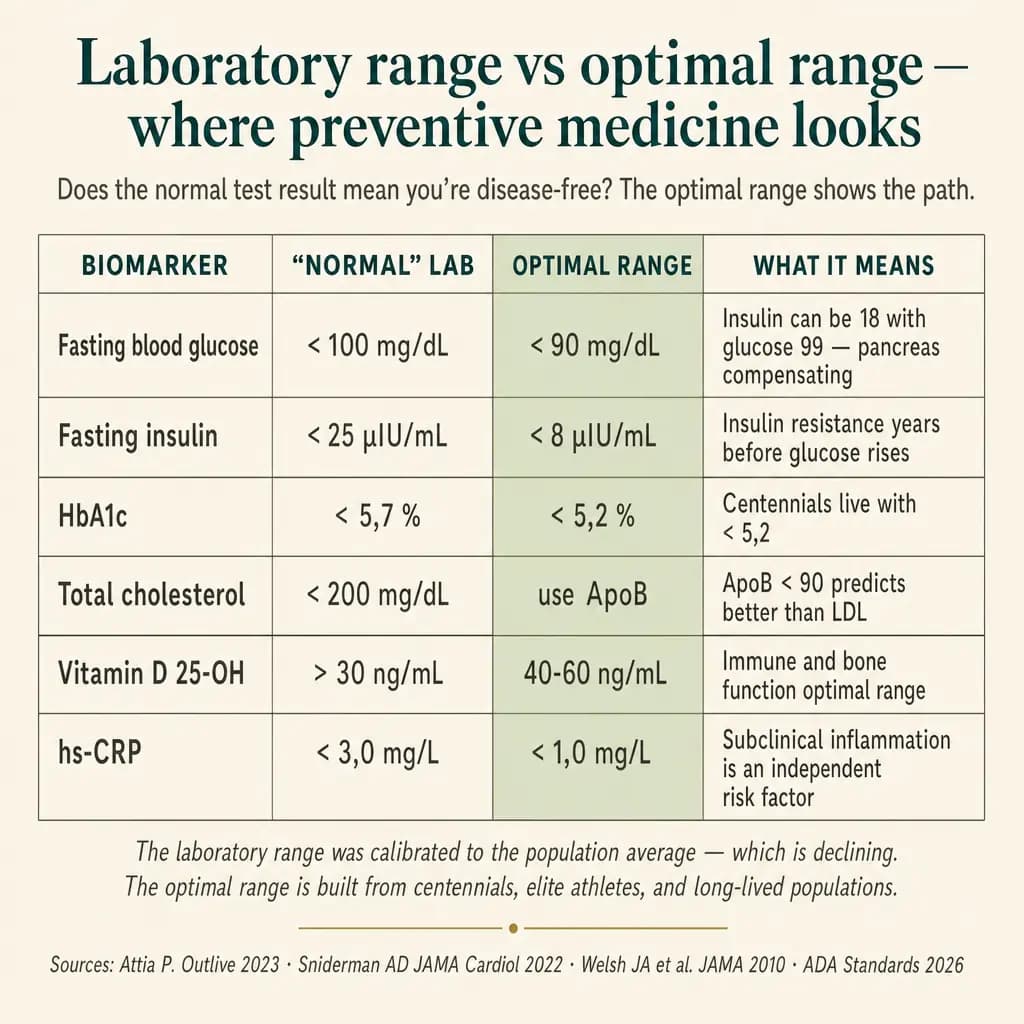
Fasting glucose 99 mg/dL is “normal.” But if your fasting insulin is at 18 µU/mL, you have had insulin resistance for years — and the pancreas has been compensating to keep glucose looking fine. The day the pancreas stops compensating, glucose climbs — and that is when the diagnosis arrives.
Total cholesterol 195 mg/dL is “normal.” But if you have 1,300 ApoB particles circulating per dL, the number of particles entering the arterial wall is high — and the risk calculation has changed completely over the last ten years. ApoB predicted cardiovascular events better than LDL-C in large population studies.
Vitamin D at 32 ng/mL is “in range.” But the reference range was built from a population in which deficiency is the norm. The physiologically optimal range — where immune, bone, and neuromuscular regulation happens without pressure — is higher.
The list our team works through is long: ferritin, free T3, hs-CRP, ApoB, Lp(a), homocysteine, glycated hemoglobin at a curve point, free testosterone, SHBG. None of these markers appears on a basic checkup. Almost all of them matter — before any symptom.
Normal is not the same as optimal
There is an operational difference between these two categories that we apply through The ACTS Method (Activity, Alimentation & Smart Adjuncts · Clinical Optimization · Tending Mind, Body & Bonds · Sleep, Rhythm & Recovery).
Normal is a population statistic. It says where the majority is.
Optimal is a physiologic range. It says where the body operates with margin — without subclinical inflammation, without compensatory overload, without the silent wear that becomes a diagnosis ten years from now.
Reactive medicine works with normal. Preventive medicine — what our team practices — needs to work with optimal. They are different games.
What Continuum Plenya measures differently
When someone enters our program, the first thing we do is build an expanded panel. It is not “many more tests for many more tests” — it is the reading of the set that matters.
The Plenya Score consolidates more than 800 items — history, symptoms, habits, medications, labs. Each one weighed, cross-referenced, read in context. The result is not a page of numbers: it is a single score and a map of what is well, what is on margin, and what needs intervention now.
The practical difference: you leave knowing what trajectory you are on. Not “all normal,” not “all sick.” The exact point at which your body is, with the precision needed for our team to decide what to do.
What changes in follow-up
Measuring once is not enough. Trajectory is reading over time.
Every three months, follow-up labs as clinically indicated. Every four weeks, a meeting with one of the four professionals on our team. Each month, one area of ACTS is reviewed. The panel updates, the reading refines, the management adjusts.
It is no longer “come back in a year for the next checkup.” It is you are in motion — and we follow the motion.
The sentence that matters
Normal is not the same as optimal. Medicine has changed. The tools to see trajectory exist. What still needs to change is the expectation that an annual exam with 12 basic markers is enough to answer the question you are actually asking:
Am I well — or am I just undiagnosed?
They are different questions. And, in our team's view, they deserve different answers.
References
- Welsh JA et al. Caloric Sweetener Consumption and Dyslipidemia Among US Adults. JAMA, 2010;303(15):1490-1497.
- Sniderman AD et al. Apolipoprotein B Particles and Cardiovascular Disease: A Narrative Review. JAMA Cardiol, 2019;4(12):1287-1295.
- Attia P. Outlive: The Science and Art of Longevity. Harmony, 2023.
Recognition
Does this text describe what you feel?
If so, it may be worth understanding how Continuum Plenya delivers this kind of care. Five short questions return a reading — or the team can listen to you directly.